
The Final Reckoning: How World Cup 2026 Betting Markets Played Out
 Available in US
Spain have lifted the trophy at MetLife Stadium, the individual awards have been handed out, and every market that mattered has settled. Time to go through the ledger.
The 2026 World Cup delivered for favourites in most places and punished them brutally in one. Spain, the pre-final outright favourite at approximately 1.67, won the tournament in extra time. Kylian Mbappé, the Golden Boot chalk at 1.04, claimed the award with 10 goals. Unai Simón, the Golden Glove favourite at 1.13, kept seven clean sheets and won as expected. (All prices below are pre-final closing lines, July 19, 2026, before kickoff, unless stated otherwise.)
But the Golden Ball? That was a massacre. Lionel Messi went into the final priced around 1.11 to win the tournament’s best-player award. He finished with the Silver Ball. The winner, Spain’s Rodri, was available at approximately 11.00 — the one market in the entire tournament where the favourite lost.
For Canadian bettors, the 2026 World Cup turned into a running seminar on the difference between chalk and value, between narrative and performance, and between what the market prices and what actually happens on the pitch.
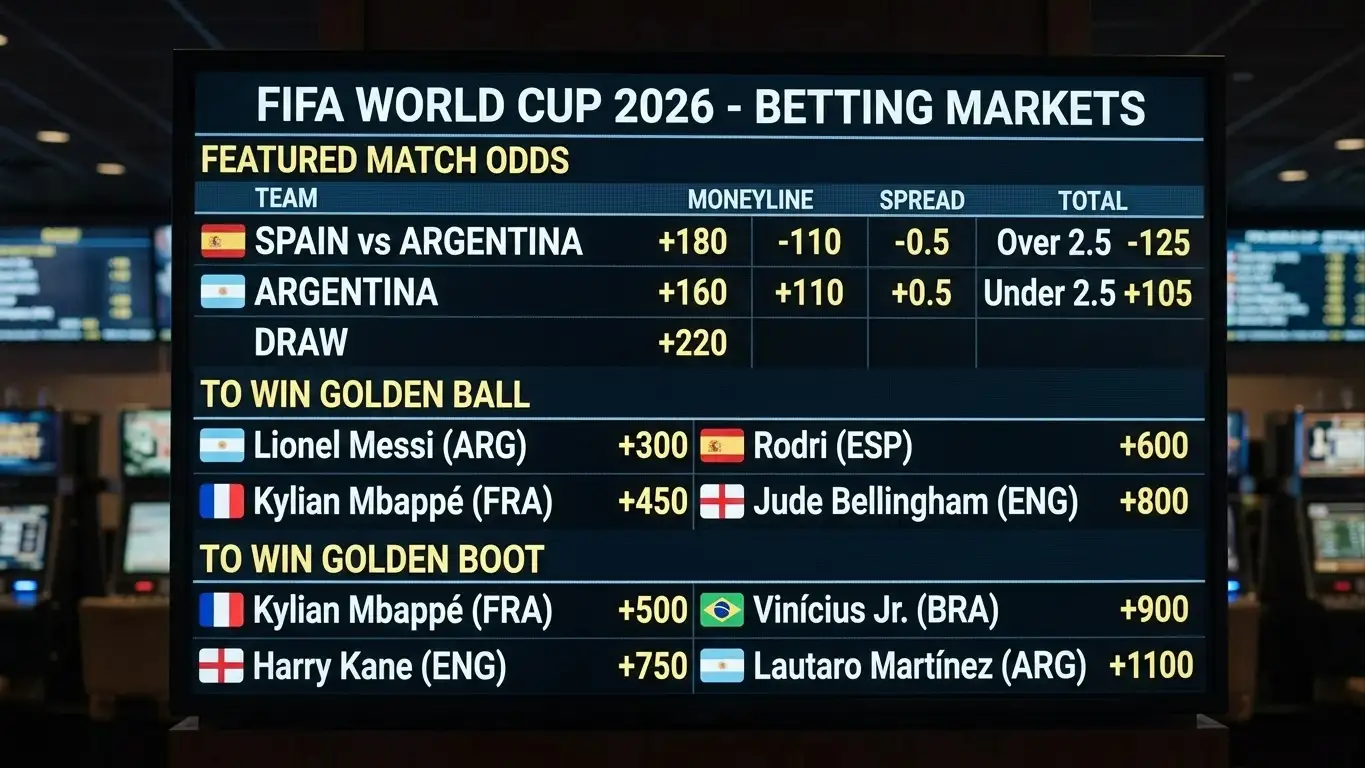
A sportsbook odds board displays World Cup 2026 final markets before settlement, showing the prices that would define winners and losers
The Outright Market: Spain Delivered as Favourite
Pre-final outright prices (July 19, 2026, before kickoff):
- Spain to lift the trophy: 1.67 (with 1.72 available at the wider end of the market)
- Argentina to lift the trophy: 2.30
Spain won 1-0 in extra time. The favourite delivered — but it took 106 minutes and a substitute’s goal to get there, and for 90 of those minutes the scoreboard said the market was wrong.
What it meant in practice: a C$100 stake on Spain at 1.67 returned C$167 in total — C$67 profit. A C$100 stake on Argentina at 2.30 returned nothing. That’s the shape of a short-priced favourite market: correct, and barely worth the risk.
Spain won all eight of their matches and conceded a single goal across the tournament, so the price was defensible. But 1.67 on a team that needed extra time against ten men is a thin margin for error. The full run-up to those numbers is tracked on our World Cup 2026 odds page.
The Golden Ball Market: Rodri’s 11.00 Upset
This is where the tournament’s one genuine market failure occurred.
Pre-final Golden Ball prices (July 19, 2026, before kickoff):
- Lionel Messi (ARG): ~1.11
- Rodri (ESP): ~11.00
Messi was the overwhelming favourite. The market had effectively crowned him — a price around 1.11 implies roughly a 90% chance. The narrative was irresistible: the 39-year-old playing his final World Cup, leading Argentina towards back-to-back titles, adding one more Golden Ball on the way out.
Then the final happened. Messi was held scoreless across 120 minutes. Argentina managed zero shots on target. And the voters chose Rodri — the midfielder who anchored every match Spain played, who finished the edition with roughly 756 completed passes (a single-edition record, past Xavi’s 599 from 2010), and who captained the tournament’s best defence.
What it meant in practice: a C$100 stake on Rodri at 11.00 returned C$1,100 in total — C$1,000 profit. A C$100 stake on Messi at 1.11 returned nothing. Same event, same 120 minutes, a C$1,100 swing between the two tickets.
The instructive part isn’t that the outsider won. It’s why the price was wrong. The Golden Ball is voted on tournament-long performance, not on the final alone and not on career standing. A midfielder who controls eight matches for the champion is a serious candidate under those criteria. The market priced the story instead — and a 1.11 favourite losing isn’t a bad beat, it’s evidence the consensus had misread how the award is actually decided. We broke down the shape of that market in our Rodri Golden Ball upset feature.
The Golden Boot Market: Mbappé Cruised Home
Pre-final Golden Boot prices (July 19, 2026, before kickoff):
- Kylian Mbappé (FRA): 1.04 — 10 goals
- Lionel Messi (ARG): 13.00 — 8 goals
Mbappé scored twice in France’s 6-4 bronze-match defeat to England on July 18, taking his tally to 10. That brace was the decisive move in the market: it opened a two-goal gap with one game left, meaning Messi needed a hat-trick in the final merely to draw level. Against a Spain side that had conceded one goal all tournament, that was a prayer, and 13.00 priced it as one.
Spain held Messi scoreless. Mbappé took the Golden Boot with 10 goals, becoming the first player to win the award at two World Cups.
What it meant in practice: at 1.04, a C$100 stake returned C$104 — C$4 profit. Correct, and almost pointless. The Golden Boot market was fully efficient by the time the final arrived; whatever value existed had been extracted while the race was still open. That’s the argument for engaging with a top-scorer market early rather than at the death — the reasoning behind our World Cup golden boot odds guide.
The Golden Glove Market: Simón Delivered
Pre-final Golden Glove price (July 19, 2026, before kickoff):
- Unai Simón (ESP): 1.13
Simón went into the final having set a record six consecutive World Cup clean sheets spanning the 2022 and 2026 tournaments, with Spain having conceded just one goal all tournament. He kept a seventh clean sheet in the final and won the award.
Emiliano Martínez made 11 saves in the final — the most ever recorded in a World Cup final — and it made no difference to this market. Clean sheets, not saves, are what the Golden Glove rewards. A goalkeeper can have the better individual game and still lose the award to the one playing behind the better defence.
The 90-Minute Result: The Draw Hit
Here’s the wrinkle that caught plenty of bettors off guard.
Pre-final 1X2 prices, 90 minutes only (July 19, 2026, before kickoff):
- Spain: 2.25–2.30
- Draw: 2.95–3.00
- Argentina: 3.60
The match was 0-0 after 90 minutes. Spain won 1-0 in extra time.
So the 90-minute 1X2 settled as a draw, while the outright "to lift the trophy" market settled on Spain. Both are correct. They are different bets on the same match.
- A C$100 stake on Spain in the 1X2 lost — Spain won the World Cup, and the ticket was still a loser.
- A C$100 stake on the draw at 3.00 returned C$300 — C$200 profit, on a match the backer’s team didn’t win.
- A C$100 stake on Spain to lift at 1.67 won, because that market includes extra time and penalties.
This distinction is the single most common source of confusion in tournament betting. “90 minutes” means regulation only. “To lift” or “to qualify” means the result after extra time and penalties. If you don’t check which one you’re in, you can be right about the tournament and wrong about the bet. Our World Cup betting markets explainer covers exactly this.
The anytime-scorer market told a similar story. The listed favourites — Messi at 2.50, Mikel Oyarzabal at 2.60, Lamine Yamal at 3.30 — all failed to score. The goal came from Ferran Torres, a 62nd-minute substitute who hadn’t scored all tournament and sat deep in longshot territory.
The Scoreboard: Which Favourites Delivered
| Market | Favourite | Closing price | Result | Favourite won? |
|---|---|---|---|---|
| Outright (to lift trophy) | Spain | 1.67 | Spain won (aet) | Yes |
| Golden Ball | Messi | ~1.11 | Rodri won | No — biggest upset |
| Golden Boot | Mbappé | 1.04 | Mbappé won | Yes |
| Golden Glove | Simón | 1.13 | Simón won | Yes |
| Final 1X2 (90 min) | Spain | 2.25–2.30 | Draw (0-0) | No |
Three of five delivered. The two that didn’t punished chalk backers hard — and in the Golden Ball’s case, at a price that implied near-certainty.
Lessons for Canadian Bettors
Three things this tournament made concrete:
Short prices need to be right, and even then they barely pay. Spain at 1.67, Mbappé at 1.04, Simón at 1.13 — all correct, all returning between four and 67 cents on the dollar. Being right on chalk is not the same as making money.
The market prices stories, and stories are not outcomes. Messi at 1.11 for the Golden Ball wasn’t a probability estimate; it was a narrative wearing a probability’s clothing. Rodri’s case was sitting in plain sight in the data — eight matches controlled, a passing record, the best defence in the tournament — and the board had him at 11.00.
Know which market you’re actually in. A Spain backer could have watched their team win the World Cup and lost the bet, purely because they took the 90-minute line instead of the outright.
For a fuller account of how the tournament itself played out, see our Spain World Cup 2026 final wrap, and for the underlying odds mechanics, our World Cup 2026 betting guide.
Where Canadian bettors can look for future tournament value:
- Boomerang Bet – Offers early outright markets on major tournaments
- BetiBet – Features niche player props, including award markets
- WinRolla – Provides tournament futures alongside standard match markets
Always bet responsibly. Set limits before placing wagers, and only bet what you can afford to lose. If you or someone you know needs help, contact ConnexOntario at 1-866-531-2600.
- Spain delivered as outright favourite at 1.67, but needed extra time against ten men
- Rodri’s Golden Ball win at 11.00 was the tournament’s only favourite-loses market; Messi at ~1.11 lost
- Mbappé won the Golden Boot at 1.04 — correct, and worth four cents on the dollar
- The 90-minute final 1X2 settled as a draw (0-0), despite Spain winning in extra time
- Know which market you’re in: “90 minutes” and “to lift the trophy” settled differently on the same match
