
France at World Cup 2026: Les Bleus’ Quest to Reclaim Glory
 Available in US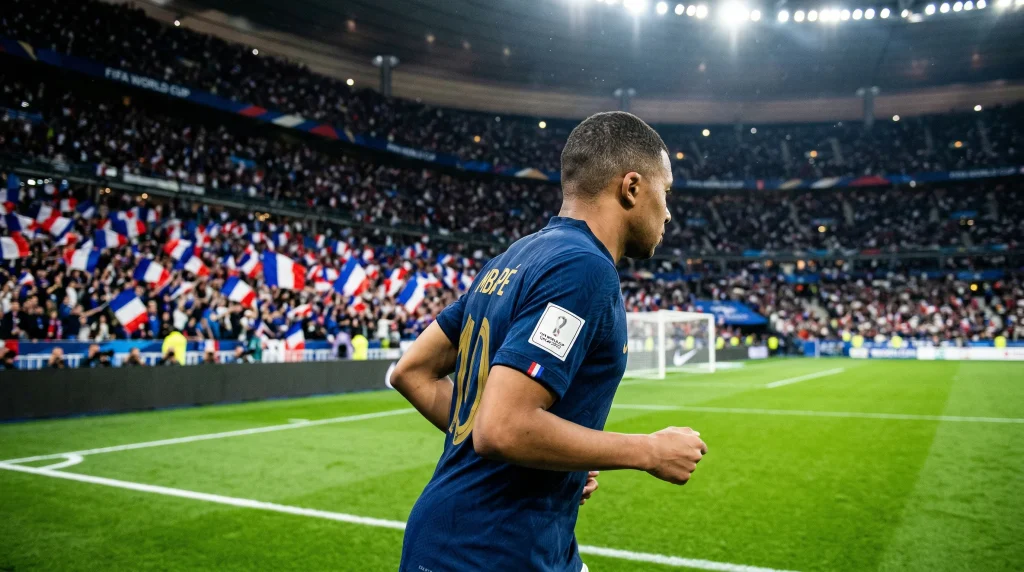
Table of Contents
Lusail Stadium, December 18, 2022. Kylian Mbappé scores a hat trick in the World Cup final — the first player to achieve that feat since Geoff Hurst in 1966. France still lose on penalties to Argentina. The cruelty of that outcome shaped everything that followed: the recovery, the rebuild, and the relentless focus on returning to the final stage with a different ending.
France World Cup 2026 represents unfinished business in its purest form. Les Bleus have reached two consecutive World Cup finals, winning in 2018 and losing in 2022. The squad that assembles in North America combines proven championship pedigree with the attacking firepower that defines modern French football. They’re not favorites — Spain holds that designation after Euro 2024 — but they’re the team nobody wants to face in knockout rounds.
I’ve tracked French football through multiple cycles, and the current depth chart reminds me of the 2018 squad that lifted the trophy: balanced across positions, tactically flexible, and featuring a generational attacker in his prime years. Mbappé enters World Cup 2026 at 27 years old, physically mature and technically complete. The question isn’t whether France can win; it’s whether Didier Deschamps can orchestrate another championship run before his inevitable departure.
The 2022 Heartbreak: France Returns for Redemption
That final in Qatar should have belonged to France. They trailed 2-0 at halftime, lifeless and outplayed. Then Mbappé happened — two goals in 97 seconds that rewrote the narrative. Extra time produced more drama, more Mbappé brilliance, and ultimately a penalty shootout where Kingsley Coman and Aurélien Tchouaméni missed while Gonzalo Montiel converted for Argentina.
The psychological processing of that defeat informed France’s subsequent approach. Rather than collapse into recrimination, Deschamps used the near-miss as motivational foundation. Players who experienced the final carry scars that drive preparation intensity. They know how close they came, and they know what prevented the trophy from returning to Paris. That knowledge shapes training sessions, tactical meetings, and the collective determination to finish what they started.
What’s remarkable about France’s recovery is the continuity of core personnel. Mbappé remains the attacking centerpiece. Antoine Griezmann evolved into a deeper creator role that serves the team’s structure. Defensive foundations, though adjusted through natural transition, maintain organizational principles that Deschamps has refined across multiple tournament cycles. The system absorbed the Qatar disappointment and emerged with renewed purpose.
The 2022 final experience also provides tactical reference points for knockout pressure management. Players who performed in that environment understand the intensity that semifinals and finals generate. They’ve processed the adrenaline, managed the emotions, and executed under conditions that destroy unprepared competitors. This experiential advantage compounds when facing opponents who’ve never reached equivalent stages.
French Qualifiers: Cruise Control
France’s European qualification campaign confirmed their status among the continent’s elite without revealing much about tournament-level ceiling. The group featured Netherlands, Greece, Ireland, and Luxembourg — a mix of competitive and trivial fixtures that France navigated with characteristic efficiency. Eight wins, minimal goals conceded, and comfortable margins throughout.
The Netherlands matches provided the only genuine tests. Both fixtures featured tactical chess between managers who respected each other’s systems. France’s pragmatic approach — defend solidly, counter through Mbappé’s pace, convert chances with clinical precision — proved effective against Dutch possession ambitions. These results demonstrated that Deschamps’ formula remains viable against quality opposition even as personnel evolves.
Qualifying also allowed integration of newer faces into the system. Young midfielders earned minutes alongside established stars, developing familiarity with positional demands and tempo expectations. Defensive options beyond the first-choice pairing gained experience in competitive environments. This depth-building creates tournament resilience that France will need across potential seven-match campaigns.
The goal-scoring distribution during qualification raised interesting questions. Mbappé’s output dominated as expected, but contributions from secondary options suggested the burden could spread when necessary. Griezmann’s creative statistics remained elite, facilitating chances that others converted. The attacking ecosystem functions regardless of which pieces start on any given day — exactly what championship teams require.
Les Bleus’ Arsenal: Depth and Star Power
French squad selection conversations inevitably begin and end with the same observation: the depth is absurd. Players who would start for most national teams struggle to make France’s preliminary roster. This competitive pressure elevates standards throughout the system, with fringe options maintaining elite fitness levels and tactical awareness despite uncertain playing time.
Goalkeeping features Mike Maignan as the established number one following Hugo Lloris’s retirement. Maignan’s shot-stopping and distribution match the modern goalkeeper requirements that tournament football demands. His personality — confident bordering on confrontational — provides vocal leadership that defenses require. Backup options offer quality insurance without threatening the starting hierarchy.
Defensive personnel has evolved since 2022 while maintaining organizational principles. The center-back positions feature options who can operate in back-four or back-three configurations depending on tactical requirements. Full-back depth includes both attacking-oriented and defensive-first profiles, allowing Deschamps to match opponent threats. The flexibility across defensive roles mirrors France’s broader tactical adaptability.
Midfield construction balances different functional profiles. Holding midfielders provide screening and distribution from deep positions. Box-to-box options add running power and goal threat from secondary areas. Creative midfielders — though France’s system uses them differently than possession-based teams — offer passing quality in the final third. Each profile serves specific tactical purposes that Deschamps deploys based on match requirements.
Kylian Mbappé: The Heir Apparent
The statistical case for Mbappé’s greatness requires no elaborate construction. Goals scored, chances created, defenders beaten, match-winning moments delivered — every metric confirms what the eye test reveals instantly. He operates at speeds that defenders cannot match, with technical quality that his pace would render unnecessary for lesser players. The complete attacking package enters World Cup 2026 in his athletic prime.
What separates Mbappé from other elite forwards is his decisive impact in the matches that matter most. His World Cup record reads like fiction: seven goals in the 2022 tournament including the final hat trick, four goals in the 2018 run that ended with France lifting the trophy. When stakes elevate, Mbappé elevates further. This championship mentality distinguishes genuine greats from merely excellent players who shrink under pressure.
The transition to Real Madrid in 2024 added new dimensions to Mbappé’s game. Playing alongside different creative personnel required adaptation that refined his movement patterns and finishing variety. The Bernabéu expectations accelerate development that was already ahead of schedule. By June 2026, Mbappé will have accumulated experience at the highest club level that complements his international trophy cabinet.
Defensively, Mbappé has matured from his earlier refusal to track back. Deschamps demands contribution from all players, and Mbappé now applies selective pressure that triggers coordinated pressing sequences. This evolution transformed France’s out-of-possession approach, allowing higher defensive lines because Mbappé’s closing speed prevents simple outlets to opposing full-backs.
The Midfield Engine
France’s midfield philosophy prioritizes function over individual brilliance. Unlike Spain’s technical passing triangles or England’s star-studded options, Les Bleus construct their central areas around complementary profiles that serve the team’s counter-attacking identity. Runners who cover ground, winners who recycle possession, and connectors who link defense to attack — each role clearly defined.
Aurélien Tchouaméni anchors the midfield triangle with physical presence and progressive passing. His development at Real Madrid accelerated timelines, transforming him from promising youngster to essential piece in Deschamps’ planning. The penalty miss in the 2022 final could have haunted his career; instead, he’s used it as fuel for improvement that’s visible in every subsequent performance.
The supporting midfield options offer tactical versatility. More defensive profiles provide solidity against possession-dominant opponents. More creative profiles unlock against deep blocks that require patience and precision. Deschamps’ selection depends on opposition analysis, ensuring that France’s midfield profile matches the specific challenge each match presents.
Defensive Reliability
French defensive organization under Deschamps has always prioritized clean sheets over aesthetic appeal. The system accepts less possession than purists prefer, retreating into compact shapes that deny space while positioning for quick transitions. This pragmatic approach frustrates opponents who expect open matches and plays directly to French attacking strengths.
Center-back partnerships have evolved through necessity as the 2018 winners aged out. Newer options bring different profiles — some better in the air, others quicker in recovery, all drilled in the positional discipline Deschamps demands. The adjustment period following Raphaël Varane’s retirement created temporary vulnerability, but the current options have stabilized through accumulated minutes together.
Full-back positions feature established quality with emerging competition. Theo Hernandez’s attacking threat from left-back remains elite, though his defensive positioning occasionally creates exposure. The right-back options offer more balanced profiles, contributing in both directions without exceptional output in either. This asymmetry in full-back profiles reflects tactical choices rather than personnel limitations.
Tactical Flexibility: Deschamps’ Chess
Didier Deschamps doesn’t coach beautiful football. He coaches winning football. The distinction matters when evaluating France’s tournament prospects because aesthetic criticism misses the fundamental point: his methods work. World Cup 2018 champion. World Cup 2022 finalist. Nations League winner. The trophy case validates the approach regardless of pundit complaints about negative tactics.
France’s base structure features a 4-3-3 or 4-2-3-1 depending on opponent and available personnel. The formations share common principles: defensive compactness, quick transitions through wide areas, and clinical finishing from limited high-quality chances. Possession statistics often favor opponents; results favor France. This exchange rate works because the chances France create convert at elite rates.
Set-piece preparation demonstrates the attention to detail that separates good tournament teams from great ones. Defensive organization on corners and free kicks minimizes concession of cheap goals. Attacking routines maximize the aerial presence and movement quality that French personnel offer. These marginal gains compound across seven-match tournament runs.
In-game adjustments show Deschamps at his tactical best. When plans A and B fail, France have plans C through F ready for deployment. The substitution timing, formation shifts, and personnel changes respond to match dynamics rather than predetermined scripts. This reactive flexibility requires deep squad understanding and player buy-in — both of which Deschamps has cultivated through years of continuity.
The counter-attacking philosophy that Deschamps has perfected serves France particularly well in knockout football. When margins shrink to single goals, the team that defends with discipline and punishes mistakes typically advances. France’s willingness to cede possession while maintaining structural integrity frustrates opponents who expect open, attacking football. The approach may lack romance, but the results speak for themselves.
Group I Analysis: Senegal, Norway, Iraq
France’s group draw provided what realistic observers would term a “manageable” path to the knockout rounds. Senegal, Norway, and Iraq present different challenges without threatening France’s qualification unless catastrophic underperformance occurs. The expectation is nine points from three matches; anything less constitutes disappointment.
Senegal represents the most credible group-stage threat. Their AFCON success demonstrated organizational quality and individual talent concentrated in specific positions. The African champions will press high, run tirelessly, and create transitional chaos that favors their athletic profile. France’s experience in managing these physical matches — controlling tempo without surrendering space — should prove decisive.
Norway means Erling Haaland, and Haaland means guaranteed threat regardless of surrounding quality. His movement and finishing create goals from minimal service, requiring France’s center-backs to maintain perfect concentration throughout 90 minutes. The tactical challenge involves denying Haaland supply while exploiting Norway’s relatively modest options elsewhere. Deschamps will prioritize defensive solidity, trusting that Mbappé can produce attacking moments without systemic support.
Iraq returns to the World Cup after 40 years of absence, making their participation more ceremonial than competitive. The squad lacks European club experience, and the preparation pathway cannot match France’s resources. This fixture allows rotation for key French players, preserving fitness for knockout rounds while still securing comfortable victory.
The group schedule positions France favorably for knockout-round freshness. By managing minutes across all three fixtures — full strength against Senegal, tactical rotation against Norway, widespread rest against Iraq — Deschamps can enter the Round of 32 with a squad that hasn’t accumulated excessive fatigue. This load management strategy proved effective in previous tournaments and remains central to French preparation philosophy.
World Cup DNA: France’s Modern Legacy
Since 1998, France has contested four World Cup finals — winning twice (1998, 2018) and losing twice (2006, 2022). This modern legacy establishes French football among the tournament’s elite producers of championship teams. The infrastructure, development systems, and competitive culture create sustainable excellence rather than isolated peaks.
The depth of French footballing talent reflects demographic and developmental advantages unique among European nations. Population diversity combines with extensive academy networks to produce quantity and quality simultaneously. Players emerge from Paris suburbs, provincial clubs, and overseas territories — each pathway feeding the national team pool with distinct characteristics.
Deschamps himself embodies the championship mentality that French football demands. As a player, he captained the 1998 World Cup and Euro 2000 winning teams. As a manager, he’s replicated that success while maintaining squad harmony that other managers struggle to achieve. His eventual departure, whenever it arrives, will test whether French football’s institutional strengths transcend individual leadership.
The continuity under Deschamps provides competitive advantage that transitioning programs cannot match. Players understand expectations, tactical responsibilities, and behavioral standards from their first call-up. This institutional knowledge reduces adjustment periods and accelerates integration of younger players into the senior setup. When tournament football arrives, there’s no learning curve — only execution of familiar principles in high-pressure environments.
France as Value: Third-Favorite Analysis
Current World Cup 2026 odds place France around +750, behind Spain and England in the betting hierarchy. This third-favorite pricing reflects both the quality gap revealed at Euro 2024 — where France exited to eventual champions Spain — and the lingering questions about attacking production beyond Mbappé dependency.
My assessment suggests France’s actual probability of winning the tournament sits around 10-12%, translating to fair odds between +735 and +900. At +750, you’re getting approximately fair value with slight potential edge depending on which end of the probability range proves accurate. The market prices France correctly relative to Spain but may undervalue them relative to England.
Group I advancement should price around -600 based on the quality differential between France and their opponents. There’s minimal value backing heavy favorites, but the certainty approaches guarantee. France to win Group I at approximately -300 captures the expectation that maximum points arrives without significant resistance.
The more interesting proposition involves France’s tournament path. If they avoid Spain’s bracket portion through seeding dynamics, the path to the final becomes substantially easier. France to reach the final at +250 offers value if bracket draws break favorably, capturing the possibility of avoiding their toughest competitor until the final match.
Value Picks for France Bettors
I’m taking France to win Group I with a -2.5 goal difference margin at +120. The combined quality gap between France and all three opponents should produce comfortable victories in each fixture. Senegal provides resistance but ultimately lacks the firepower to trouble French defensive organization. Norway’s Haaland dependency creates predictable defensive assignments. Iraq offers minimal challenge.
For individual matches, France versus Norway presents actionable opportunity. The spread likely opens around France -1.5, which captures my expectation that France controls the match while limiting Haaland’s service. Taking France to win to nil against Iraq — likely priced around -130 — offers near-certain return with reasonable odds.
Mbappé’s Golden Boot candidacy deserves position at +800. If France reaches the semi-finals or beyond, Mbappé’s goal involvement will accumulate rapidly. His tournament scoring record suggests elevated performance when World Cup matches arrive, and the group-stage fixtures provide opportunities for multi-goal performances that establish early advantage in the scoring race.
The Champion’s Mentality
France enters World Cup 2026 with something that cannot be coached: collective memory of winning the biggest matches in football. The 2018 champions remain in the squad, providing leadership and standard-setting that younger players absorb through proximity. This championship DNA transmits through the group, creating expectations that normalize tournament success rather than treating it as exceptional achievement.
The redemption narrative provides additional motivation that manufactured goals cannot replicate. Players who stood on the Lusail podium receiving silver medals carry that image into every subsequent training session. The 2022 final defeat didn’t break France — it hardened them. That distinction matters when knockout matches require mental fortitude to overcome adversity.
My tournament prediction places France among the final four teams standing when the knockout rounds conclude. Their path through Group I should preserve fitness and confidence, building momentum for the elimination matches where Deschamps’ tournament management proves most valuable. Whether the trophy returns to Paris depends on bracket dynamics and individual brilliance in decisive moments. Mbappé tends to produce those moments.
