
USA at World Cup 2026: American Soccer’s Defining Moment
 Available in US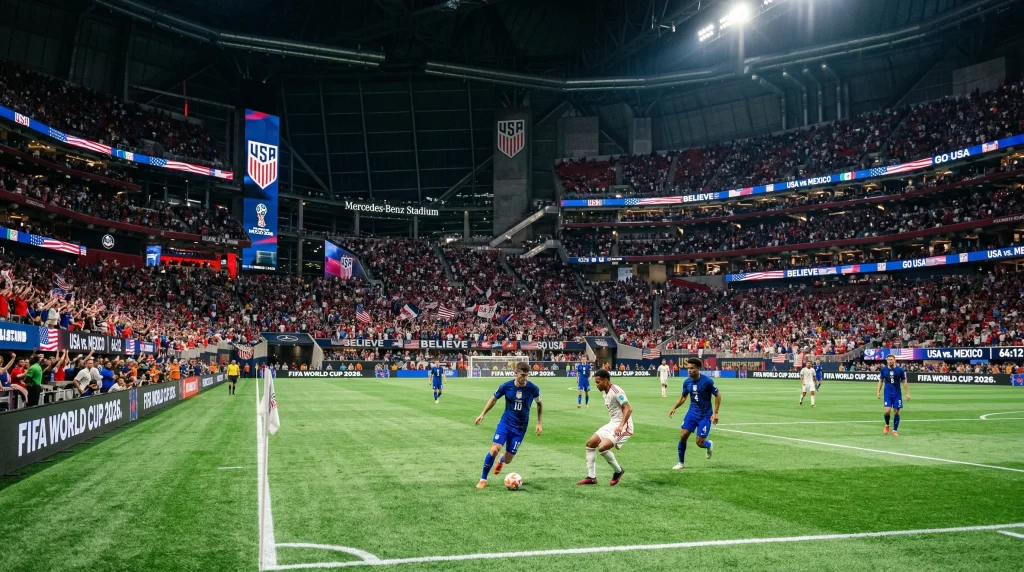
Table of Contents
The last time America hosted a World Cup, soccer barely registered in the national sports consciousness. 1994 felt like borrowed enthusiasm — packed stadiums filled with immigrant communities and curious locals who returned to baseball and football once the tournament departed. Three decades later, the landscape has transformed beyond recognition. MLS operates as a legitimate league. American players compete at Europe’s highest levels. And the sport that seemed perpetually “almost there” finally commands genuine domestic attention.
USA World Cup 2026 represents the culmination of decades of infrastructure investment, youth development reform, and cultural shift. The USMNT enters their home tournament with European-based talent that previous American generations couldn’t produce. Christian Pulisic, Weston McKennie, Tyler Adams, and emerging prospects create a core that belongs in discussions of genuine contenders rather than hopeful participants. Alongside co-hosts Canada and Mexico, the North American trio shares the spotlight — but America commands the largest stage.
I’ve analyzed American soccer’s evolution since the dark days of missing World Cup 2018. The failure to qualify for Russia forced reckoning that ultimately accelerated development timelines. Younger players received opportunities that comfortable qualification might have denied them. Coaching philosophies shifted toward technical development over athletic reliance. The painful absence created conditions for the promising present.
Soccer’s Coming Home: America’s Moment
Hosting the World Cup transforms everything about tournament preparation. The travel burden disappears. Time zone advantages materialize. And the crowd energy that neutralizes opponent momentum becomes constant companion rather than occasional luxury. These factors compound across seven potential matches, creating cumulative advantage that visiting nations cannot replicate regardless of squad quality.
The eleven American venues span the country’s football landscape, from MetLife Stadium hosting the final to SoFi Stadium’s opening American fixture. Each location brings regional identity and passionate support that soccer’s growing domestic fanbase will provide. The atmosphere inside these stadiums will rival anything European nations generate at home — perhaps exceeding it given American sports culture’s capacity for spectacle.
What makes 2026 different from 1994 involves the organic growth of soccer culture between tournaments. MLS has produced homegrown talent that feeds the national team pipeline. Youth academies operate at professional standards. And the generation currently playing for USMNT grew up when Landon Donovan and Clint Dempsey proved Americans could compete internationally. They inherit belief rather than having to manufacture it.
The pressure of hosting cuts both ways. Expectations from a nation discovering soccer enthusiasm demand results that validate the sport’s growing prominence. Failure at home would set back American soccer’s cultural progress substantially. The players understand this weight — they embrace it publicly while managing it privately. How they handle home tournament pressure determines whether 2026 becomes foundation for sustained success or cautionary tale about premature expectations.
The American Soccer Evolution
American soccer development has transformed fundamentally since the pay-to-play academy system began yielding to professional pathways. MLS teams now invest in youth development that identifies talent early and provides coaching that matches European standards. The “Dual National” recruitment that once defined American roster construction has given way to domestic production that reduces reliance on players choosing USMNT over other options.
The European migration that seemed exceptional a decade ago has become expected trajectory for top American prospects. Bayern Munich, Chelsea, Juventus, and other elite clubs actively recruit from American academies. This exposure accelerates development that domestic competition alone cannot provide. Players who might have peaked in MLS now refine their abilities against the world’s best weekly.
Tactical sophistication has grown alongside technical improvement. American players no longer rely primarily on athletic advantages that international opponents can neutralize. The current generation combines physical capacity with tactical intelligence — understanding positional responsibilities, pressing triggers, and spatial manipulation that modern football requires. This evolution reflects coaching improvements at every level.
The depth beyond starting eleven has expanded dramatically. Where previous American squads featured clear hierarchy with substantial drop-off to reserves, the current pool offers genuine competition for positions. This competitive pressure elevates standards while providing tournament resilience against injuries and suspensions. The days of depending on eleven players plus prayers have ended.
The managerial stability that Gregg Berhalter has provided, despite the controversy surrounding his reappointment, created tactical continuity that player development requires. The system’s principles remain consistent across preparation windows, allowing players to understand responsibilities without constant relearning. This stability contrasts with the managerial turnover that disrupted previous American cycles and enables the coherent identity that tournament football rewards.
The Squad: European Experience Meets MLS Roots
American squad construction for World Cup 2026 reflects the hybrid development model that produced this generation. European-based players provide the technical ceiling and competitive experience that tournament football demands. MLS-based players contribute familiarity with domestic conditions and the hunger to prove themselves against more celebrated teammates. The combination creates depth that previous USMNT iterations lacked.
Goalkeeping has emerged as position of genuine strength. Matt Turner’s Arsenal tenure and other options provide reliability that American goalkeeping historically struggled to match. The position no longer represents vulnerability requiring protection; it offers competence that defensive structures can trust.
Defensive personnel features multiple options across formations. Center-back pairings have developed understanding through consistent selection. Full-back positions balance attacking contribution with defensive responsibility. The overall defensive organization has improved dramatically from the chaos that sometimes characterized American back lines during previous cycles.
Midfield construction centers on players who’ve established themselves at European elite. The ability to control tempo, progress possession, and screen defensively reflects development that previous American midfields couldn’t demonstrate. This central quality transforms what American attacks can achieve and what American defenses must protect.
Christian Pulisic and the Key Players
Christian Pulisic carries expectations that no American player has previously shouldered. His Chelsea and Milan careers established credentials that media attention amplifies into national prominence. When America needs individual brilliance to unlock organized defenses, Pulisic provides the creative spark that generates decisive moments. His fitness and form heading into June 2026 determine American attacking ceiling.
At 27 during the tournament, Pulisic enters his athletic prime with accumulated experience from Champions League competition, Premier League intensity, and Serie A tactical sophistication. The education European football provided has refined raw talent into complete attacking player. His ability to score goals, create chances, and maintain defensive responsibilities reflects development that American academies couldn’t complete alone.
Weston McKennie’s box-to-box presence provides energy that connects defense and attack. His Juventus career developed understanding of elite tactical environments that transfers directly to international football. The running capacity, the defensive contribution, and the late arrivals into scoring positions create midfield presence that previous American squads lacked.
Tyler Adams’ leadership and defensive midfield presence anchors American tactical structure. His ability to read danger, position appropriately, and distribute efficiently provides the foundation that more attacking teammates require. The captain’s armband reflects his importance to squad dynamics beyond statistical contribution.
Giovanni Reyna’s development from prodigious talent to consistent contributor marks the maturation that World Cup football demands. His creative quality in tight spaces adds dimension that direct approaches cannot provide. If healthy and in form, Reyna offers something different from American options — the ability to manipulate space through technique rather than speed alone.
Group D Preview: Paraguay, Australia, Türkiye
America’s group draw presented manageable opposition without clear hierarchy that guarantees advancement. Paraguay represents South American tactical discipline. Australia brings physical approach and tournament experience. Türkiye features individual quality that can produce upset results. Each opponent requires professional respect rather than assumed superiority.
Paraguay’s CONMEBOL qualification confirms competitive quality that cannot be dismissed. Their organized defensive structure and counter-attacking efficiency have troubled opponents who underestimate South American tactical sophistication. The USA must maintain patience against Paraguayan resistance, creating chances through sustained pressure rather than expecting quick breakthroughs that won’t materialize.
Australia’s 2022 World Cup run to the Round of 16 demonstrated that the Socceroos remain competitive at tournament level. Their physical profile and direct approach create matchup challenges that technical superiority alone cannot solve. The potential for Australian upset exists if American concentration lapses against opponents they might underestimate based on global reputation.
Türkiye’s talented squad has historically underperformed relative to individual quality. Their attacking options provide genuine threat that organized defenses must account for. The USA versus Türkiye fixture could determine group positioning, with both teams capable of defeating the other depending on which version appears on match day.
The scheduling of Group D fixtures provides home advantage across all three matches. American crowds will generate atmosphere that neutralizes opponent momentum and amplifies home team energy. This consistent support environment differs fundamentally from the neutral or hostile atmospheres that away fixtures typically produce.
The tactical matchups within Group D suit American strengths reasonably well. None of the opponents possess the elite pressing systems that could overwhelm American build-up play. None feature the creative individual talent that produces moments of brilliance regardless of defensive organization. The opposition profile allows American tactical identity to express itself without facing the extreme tests that Spain or France would present.
Home Field Advantage: 11 Venues
The eleven American venues hosting World Cup 2026 matches represent football infrastructure that dwarfs previous tournament hosts. MetLife Stadium’s capacity exceeds any previous World Cup final venue. SoFi Stadium’s technological sophistication showcases American sports facility investment. Each location provides modern amenities that enhance the tournament experience for players and spectators alike.
For the USMNT specifically, familiarity with venues provides subtle advantages. The playing surfaces, the stadium dimensions, the acoustics that affect communication — all become familiar through preparation matches and training sessions. Visiting nations adapt to these conditions in real time; America knows them intimately before tournament begins.
The geographic distribution of matches affects travel and recovery. American matches will minimize distance between venues when bracket positioning allows. Opponents travel continental distances between fixtures; America moves efficiently through domestic infrastructure that handles logistics seamlessly. These marginal gains compound across tournament progression.
The climate conditions across American venues in June and July present variables that preparation can address. Some venues feature extreme heat; others offer climate-controlled environments. American players and coaching staff understand these variations intimately, adjusting hydration protocols and tactical intensity based on specific venue characteristics. Visiting nations adapt without the preparation time that familiarity provides.
USA Odds and Realistic Expectations
Current World Cup 2026 odds place USA around +2000, reflecting both home advantage and the quality gap between American soccer and elite European nations. This pricing positions USA as genuine dark horse — capable of surprising but not expected to contend for championship. The market asks whether home support can compensate for squad limitations against the tournament’s best teams.
My assessment places USA’s actual championship probability around 4-6%, translating to fair odds between +1570 and +2400. At +2000, you’re getting approximately fair value with slight potential edge if home advantage proves more valuable than historical precedent suggests. The uncertainty creates opportunity for those confident in American tournament performance exceeding baseline expectations.
Group D advancement should price around -300 based on home advantage and competitive but beatable opposition. Paraguay, Australia, and Türkiye all possess quality that could produce upset results, but USA should accumulate sufficient points across three home fixtures. USA to win Group D at approximately +110 captures the expectation of competitive positioning without comfortable margin.
Value Markets for USA Bettors
I’m taking USA to advance from Group D at -300 as my primary position. Home advantage across all three fixtures creates conditions where American quality should prove sufficient. The opposition profile — competitive but not elite — suits American strengths while avoiding matchups that expose limitations against top European nations.
For individual match betting, USA versus Türkiye presents the most actionable group fixture. The spread likely opens around USA -0.5, capturing home advantage expectation. Taking USA on moneyline at approximately -130 offers reasonable return for moderate risk in what represents Group D’s marquee fixture.
Pulisic’s tournament involvement deserves attention in player markets. His goals, assists, and overall contribution statistics should accumulate across group fixtures against modest defensive opposition. Player props that capture Pulisic’s attacking output provide exposure to American success without requiring deep tournament advancement.
America’s Time
USA enters World Cup 2026 at the most promising moment in American soccer history. The infrastructure exists. The talent has developed. And home advantage provides the environmental boost that could compensate for remaining quality gaps against elite opposition. Whether America seizes this moment determines whether 2026 becomes foundation or footnote in the sport’s domestic evolution.
The ceiling for this tournament extends beyond what previous American generations could realistically pursue. Quarter-final advancement seems achievable if bracket positioning cooperates. Semi-final appearance would exceed expectations while remaining within possibility. Championship requires everything breaking favorably — home advantage maximized, bracket draws cooperating, and individual brilliance appearing when needed. Unlikely but not impossible.
My tournament prediction places USA in the Round of 16 with genuine chance at quarter-final advancement. Group D should produce comfortable positioning. The knockout rounds test whether American quality can match nations with deeper tournament pedigree. If Pulisic, McKennie, and supporting cast perform at peak levels, America could produce their best World Cup result since 2002. The moment has arrived; the response determines what follows.
