
Spain Are World Champions: The Story of How La Roja Conquered 2026
 Available in US
I still remember the moment the final whistle blew at MetLife Stadium. Thirty-nine seconds into the second period of extra time, substitute Ferran Torres had just written his name into football immortality with a left-footed finish past Emiliano Martínez. As 80,663 fans held their breath through the remaining minutes, Spain’s players counted down to a coronation that felt inevitable from the opening match in June.
On July 19, 2026, Spain became world champions for the second time, defeating Argentina 1-0 after 120 gruelling minutes under the New Jersey sun. The victory completed a double that no men’s team had ever achieved—holding the European Championship and World Cup simultaneously—and made Spain the first nation in history to possess both the men’s and women’s World Cup trophies at the same time.
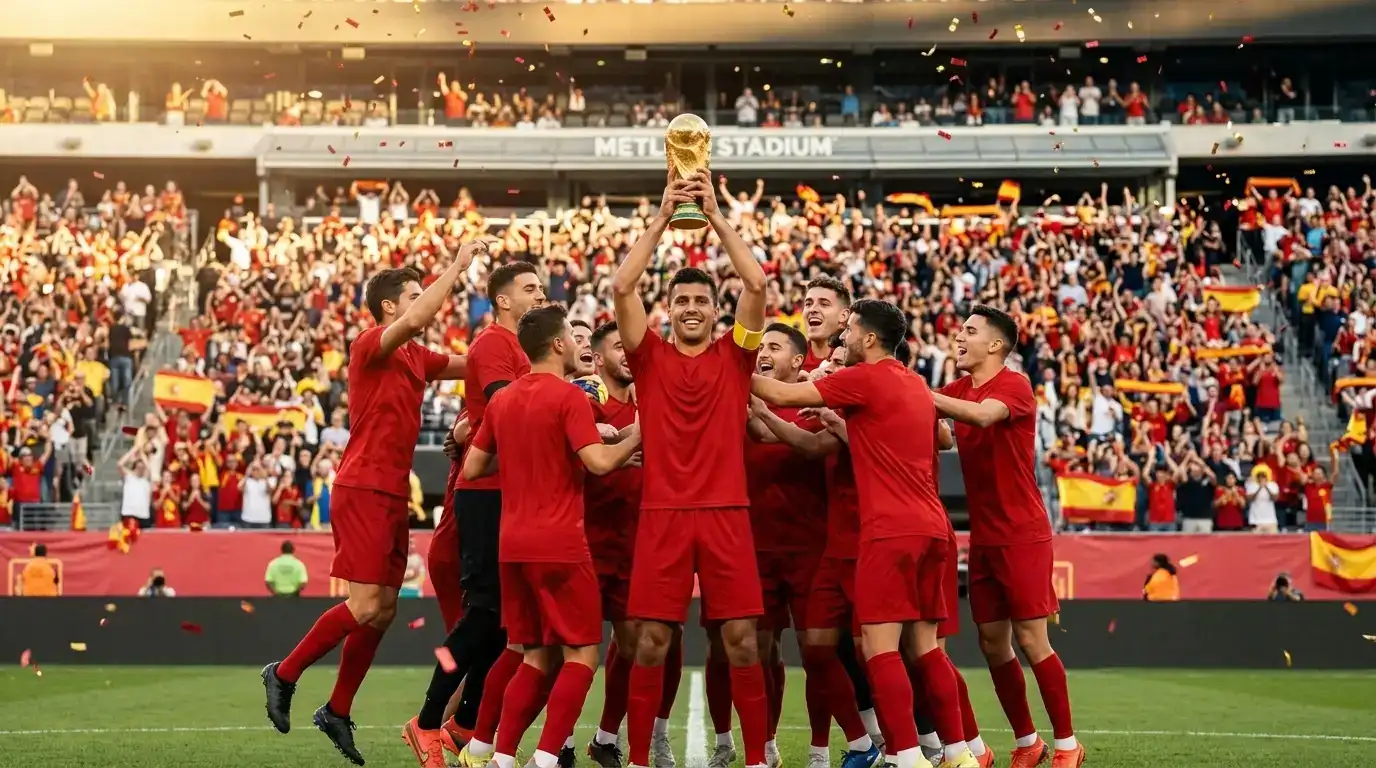
Spain captain Rodri lifts the World Cup trophy at MetLife Stadium on July 19, 2026, as teammates celebrate the nation’s second world title
A Final Decided by Substitutes
For 105 minutes and 21 seconds, the 2026 World Cup final remained scoreless. Argentina, reduced to ten men after Enzo Fernández’s 90th-minute red card for a reckless challenge on Pau Cubarsí, had absorbed wave after wave of Spanish possession without conceding a shot on target across 120 minutes.
Then came the moment that decided everything.
Pedro Porro, Spain’s marauding right-back, delivered a cross toward the far post in the 106th minute. Substitute Nico Williams rose above Nahuel Molina to win the header, directing the ball back across goal. There, lurking with predatory instinct, was Ferran Torres—himself a 62nd-minute substitute for Mikel Oyarzabal—who struck first-time with his left foot.
The ball flew past Martínez, who had made 11 saves in the match (the most ever in a World Cup final) while reportedly playing through a broken finger. Two substitutes combined for the goal that crowned a world champion. Torres, who hadn’t scored all tournament, picked the perfect moment to break his drought.
"I just saw the ball coming to me and I just shot with the power of all the Spanish people," Torres said afterward.
Rodri’s Golden Ball: The Market’s Biggest Upset
When FIFA announced the Golden Ball winner shortly after the final, it wasn’t the pre-match favourite. Lionel Messi, who entered the final priced around 1.11 (−900) to claim the tournament’s best player award, finished with the Silver Ball after being held scoreless in the championship match.
Instead, the honour went to Rodri—Spain’s midfield metronome who had been available at approximately 11.00 in the pre-final Golden Ball market. It was the awards ceremony’s most stunning upset, and perhaps its most deserving winner. We tell that story in full in our Rodri Golden Ball upset feature.
Rodri had ruptured his right ACL in September 2024, missing most of the 2024-25 season. Manchester City manager Pep Guardiola had said that "the real Rodri" would return at the 2026 World Cup. Roughly twenty months post-surgery, he anchored every one of Spain’s eight matches, completing an estimated 756 passes across the tournament—a new single-edition record, surpassing Xavi’s 599 from Spain’s 2010 triumph. His all-time World Cup career total now stands at around 1,343 passes, past Dunga’s 1,306.
"It feels like the perfect script. I certainly didn’t expect this," Rodri admitted. "I’d love for the younger generations to see that a player who touches the heavens, then descends into hell, can come back. It’s a lesson in overcoming adversity."
Spain’s Historic Double and Defensive Masterclass
Spain’s 2026 triumph wasn’t just about lifting the trophy—it was about rewriting the record books along the way.
By beating Argentina, Luis de la Fuente’s Spain side secured the Euro 2024 and World Cup 2026 double, a feat no men’s team had accomplished in the modern era. Their full route through the World Cup 2026 bracket ran eight matches without a defeat. But the achievement runs even deeper: with Spain’s women having won the 2023 Women’s World Cup, the nation became the first ever to hold both the men’s and women’s world titles simultaneously.
"I said gentlemen we have an appointment with history, and we want to be there first," de la Fuente reflected afterward.
The defensive numbers tell their own story. Spain conceded just one goal across eight matches—the fewest ever by a World Cup winner, despite playing more games than any previous champion due to the expanded 48-team format. They kept seven clean sheets, with goalkeeper Unai Simón setting a record six consecutive World Cup shutouts that spanned from the 2022 tournament into 2026.
Argentina managed zero shots on target in 120 minutes of the final. It was domination disguised as a tight match.
Spain also extended their unbeaten run to 38 matches — a new outright international record, past Italy’s 37. They had arrived at the final on 37, level with the mark; 120 minutes later it was theirs alone.
Messi’s Ending: Silver Ball and Tears
For Lionel Messi, the final represented what is widely believed to be his last appearance on football’s biggest stage. At 39 years old, the Argentine captain finished the tournament with eight goals and four assists, leading his team to within one match of back-to-back World Cup titles.
But on the day that mattered most, Messi was held scoreless. He finished with the Silver Ball, watching as Spain’s players celebrated on the MetLife turf. Reports from the medal ceremony described Messi in tears as Spain’s squad formed a guard of honour for the Argentine legend—a gesture of respect that Argentina’s players controversially did not return when Spain lifted the trophy.
"I feel sad, but I am aware that we played our hearts out," Messi said. "They were better, to be honest. We lost the game, and we accept that."
Messi leaves the World Cup stage having extended his records for most appearances (33) and most assists (12) in tournament history. But the all-time goals record? That now belongs to someone else. Our Messi World Cup farewell piece looks at what he kept and what he lost.
Mbappé’s Golden Boot in a Fourth-Place Finish
Kylian Mbappé claimed the Golden Boot with 10 goals, becoming the first player ever to win the award at two World Cups (he scored eight in 2022). His brace in France’s 6-4 bronze-match defeat to England on July 18 pushed him to 22 career World Cup goals—a new all-time record, surpassing Messi’s 21.
It’s a bittersweet achievement. Mbappé now has 22 goals in 22 World Cup matches — a goal per game across three tournaments — and he carried France’s attack to the semi-finals before Spain ended their run with a 2-0 win on July 14. He also claimed the Bronze Ball as the tournament’s third-best player. The full record chase is covered in our Mbappé all-time World Cup goals record feature.
But France finished fourth. For all his individual brilliance, Mbappé leaves the tournament without the only trophy that matters.
The Other Awards: Spain’s Clean Sweep
Spain dominated the individual honours almost as thoroughly as they dominated opponents:
- Golden Glove: Unai Simón (ESP) – Seven clean sheets and 650 consecutive minutes without conceding across tournaments
- Best Young Player: Pau Cubarsí (ESP) – The 19-year-old Barcelona centre-back who was fouled for Enzo Fernández’s red card
- Final MOTM: Ferran Torres (ESP) – The match-winner
- Silver Ball: Lionel Messi (ARG)
- Bronze Ball: Kylian Mbappé (FRA)
The only major award Spain didn’t claim was the Golden Boot, which Mbappé secured on goal difference over Messi (10 to 8). England’s Jude Bellingham and Erling Haaland both finished on seven goals, while France’s Michael Olise set a new single-tournament assist record with seven—breaking Pelé’s previous mark.
England’s Bronze, Deschamps’ Goodbye, and Final Standings
England claimed third place with a thrilling 6-4 victory over France in the bronze final on July 18 — ten goals, the most in a single World Cup match since 1982. Bukayo Saka’s hat-trick powered England to their best World Cup finish since winning the tournament in 1966.
For France, the loss marked Didier Deschamps’ final match as head coach after 14 years in charge. The 2018 champion departs with Zinedine Zidane widely expected to succeed him.
The final standings:
- Spain (Champions)
- Argentina (Runners-up)
- England
- France
The Biggest World Cup Ever
The 2026 tournament will be remembered as much for its scale as its drama. As the first 48-team, 104-match World Cup, it shattered every attendance and scoring record:
- Total attendance: 6,810,966 (all-time record)
- Average attendance: 65,490 per match
- Total goals: 308 (highest-scoring edition ever)
- Goals per match: 2.96
The tri-nation hosting across the United States, Canada, and Mexico brought the World Cup to North American soil in unprecedented fashion, with iconic venues like MetLife Stadium, BMO Field in Toronto, and BC Place in Vancouver playing host to moments that will echo for generations.
There was controversy, too—most notably when U.S. President Donald Trump phoned FIFA President Gianni Infantino after American forward Folarin Balogun received a red card in the Round of 32. FIFA subsequently suspended Balogun’s automatic ban, allowing him to play in the Round of 16. UEFA called the intervention "unprecedented, incomprehensible and unjustifiable," accusing FIFA of crossing "a red line."
And in a first for the tournament, the final featured a halftime show curated by Chris Martin, with performances from BTS, Shakira, Madonna, Justin Bieber, and others—a spectacle that drew mixed reactions but underscored the event’s ambition.
Spain’s Golden Generation Delivers
At the heart of Spain’s triumph is a Barcelona-heavy core, two of whom have now won the European Championship and World Cup before turning 20. Lamine Yamal, just 19, terrorized defences from the right wing. Pau Cubarsí, also 19, marshalled the defence alongside the veteran Aymeric Laporte. In the final, Dani Olmo and Fabián Ruiz set the midfield tempo — with Pedri on the bench — and Rodri anchored it all.
This is Luis de la Fuente’s vision realized: a youth project built on possession, pressing, and patience, shaped in the image of Barcelona’s famed academy but expanded to encompass the best of Spain’s footballing identity.
"When you look back at this process, I would not have achieved anything without these players," de la Fuente said. "The journey with this raw material, this talent. Spanish footballers, the way they compete. These players are amazing."
They are world champions. And for the first time in 16 years, the World Cup trophy returns to Spain.
What This Means for Bettors: How the Markets Settled
Closing prices below are from July 19, 2026, before kickoff of the final.
Spain went into the final as favourites at approximately 1.67 to lift the trophy, and duly delivered in extra time. Argentina backers at around 2.30 watched 120 minutes of gritty defending crumble in one moment. A C$100 stake on Spain returned C$167 — correct, and thin.
There was a wrinkle that caught out plenty of people. Because the match was 0-0 after 90 minutes, the regulation 1X2 market settled as a draw (Spain 2.25–2.30, Draw 2.95–3.00, Argentina 3.60), while the "to lift the trophy" market — which includes extra time — settled on Spain. You could have backed Spain, watched Spain win the World Cup, and still lost the bet.
The Golden Ball market provided the night’s biggest surprise. Messi, the overwhelming pre-final favourite at roughly 1.11, finished with the Silver Ball after being shut out. Rodri’s win at approximately 11.00 was the only market in the tournament where the favourite lost — a C$100 stake returned C$1,100.
The Golden Boot settled as expected, with Mbappé’s pre-final price of 1.04 reflecting his commanding lead after the bronze match. Only a Messi hat-trick could have changed it, and Spain’s defence ensured that never materialized. The Golden Glove went the same way: Unai Simón at 1.13, favourite, delivered.
Anytime scorer was where the night went strange. The listed favourites — Messi 2.50, Oyarzabal 2.60, Yamal 3.30 — all blanked. The goal came from a 62nd-minute substitute who hadn’t scored all tournament.
Full settlement across every market is broken down in our World Cup 2026 betting markets review, and the odds mechanics are explained in our World Cup 2026 betting guide.
Canadian betting options for World Cup outright and award markets:
- Boomerang Bet – early outright markets on major tournaments
- WinRolla – tournament futures alongside standard match markets
- BetiBet – same-game parlays and award props
Always bet responsibly. Set limits before placing wagers, and only bet what you can afford to lose. If you or someone you know needs help, contact ConnexOntario at 1-866-531-2600 or visit their website.
