From 11.00 Outsider to Golden Ball: Rodri’s Stunning World Cup Coronation
 Available in US
I’ve covered enough award ceremonies to recognize genuine shock when I see it. When Rodri’s name was announced as the 2026 World Cup Golden Ball winner on July 19, it landed as a surprise — because the betting markets had told a completely different story. Lionel Messi was the overwhelming favourite at approximately 1.11, while Spain’s midfield anchor was floating around 11.00 (closing prices, July 19, 2026, before kickoff of the final).
In betting terms, this was a massacre. The Golden Ball favourite not only lost—he finished second. And the winner? A defensive midfielder who hadn’t scored a single goal all tournament, who was coming back from a ruptured ACL just 20 months earlier, and who most casual fans couldn’t pick out of a lineup before June.
Rodri’s Golden Ball victory represents the biggest individual award upset in modern World Cup history. It’s also one of the most deserving.
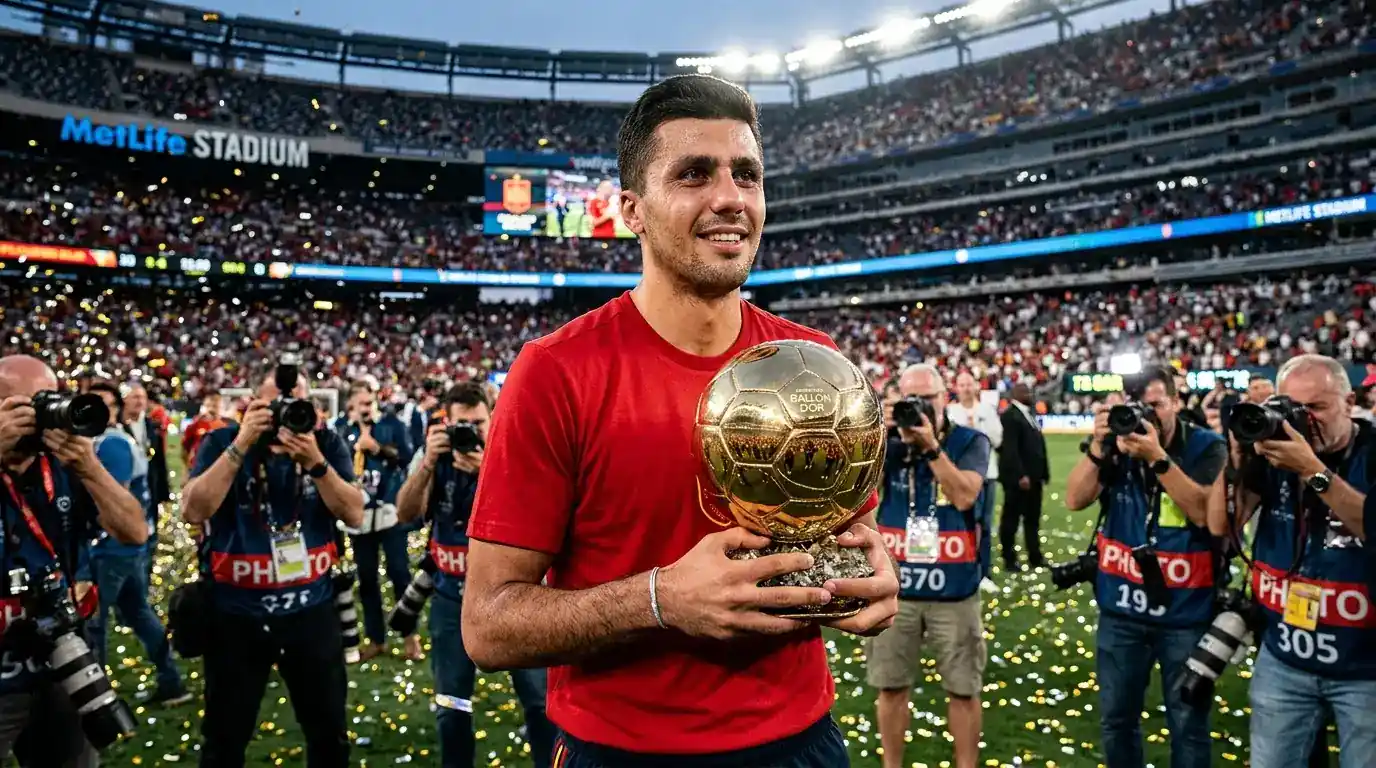
Rodri holds the 2026 World Cup Golden Ball after being named tournament MVP, defying 11.00 pre-final odds to beat favourite Lionel Messi
The Market That Got It Wrong
Let’s talk numbers first, because Canadian bettors deserve to know just how unlikely this outcome was.
Going into the final on July 19, the two prices that mattered were these (closing, before kickoff):
- Lionel Messi: ~1.11
- Rodri: ~11.00
Messi’s price reflected near-certainty — around 1.11 implies roughly a 90% chance. The market had effectively crowned him before the final whistle, banking on the 39-year-old’s eight goals, four assists, and the sentimental pull of a farewell World Cup to seal the award.
Rodri, meanwhile, was trading in longshot territory: 11.00 implies about a 9% chance. That’s the price you get when the market has decided you’re a supporting character.
The upset happened. Messi finished with the Silver Ball. Rodri took the gold.
In plain terms: a C$100 stake on Rodri returned C$1,100 — a C$1,000 profit. The same C$100 on Messi at 1.11 returned nothing. On a single award call, that’s an C$1,100 gap between the two tickets. The wider market settlement is laid out in our World Cup 2026 betting markets review.
The ACL Comeback Nobody Saw Coming
To understand why Rodri’s Golden Ball feels like such a redemption story, you need to rewind to September 2024, when he ruptured his right ACL and lost most of the 2024-25 season to it.
Manchester City manager Pep Guardiola said publicly that "the real Rodri" would return at the 2026 World Cup — a bold thing to promise about a player facing that surgery and that rehabilitation. ACL injuries don’t come with guarantees. The process is gruelling, the setbacks frequent, and the mental toll immense.
He made good on it. Roughly twenty months after the operation, Rodri walked into a World Cup as Spain’s captain and anchor.
"I’d love for the younger generations to see that a player who touches the heavens, then descends into hell, can come back," Rodri said after winning the Golden Ball. "It’s a lesson in overcoming adversity."
He anchored every one of Spain’s eight matches. He completed an estimated 756 passes across the tournament—a new single-edition record, surpassing Xavi’s 599 from Spain’s 2010 triumph. He also set the all-time World Cup career passes record with approximately 1,343, past Brazil’s Dunga’s 1,306.
He didn’t score. He didn’t provide a single assist. He just controlled the game, every game, for 120 minutes at a time.
What the Golden Ball Actually Rewards
Here’s the uncomfortable truth that the Messi-backers missed: the Golden Ball isn’t a top-scorer award. That’s what the Golden Boot is for.
The Golden Ball is voted on by journalists and FIFA’s technical study group, and it rewards the player who most influenced their team’s success across the entire tournament. Goals matter, but so do defensive contributions, game control, leadership, and the less glamorous work that doesn’t show up on highlight reels.
Messi had eight goals and four assists. Those are Golden Boot numbers, and he nearly won that award too (Mbappé’s 10 goals edged him out). But FIFA’s voters looked at Spain’s eight matches and saw something else: a midfielder who never lost control, who set the tempo in every game, who made Argentina’s vaunted attack look pedestrian in the final.
Consider the final itself. Across 120 minutes, Argentina managed zero shots on target. Not one, in a World Cup final, with Messi on the pitch. That’s not luck—that’s midfield control executed at the highest level.
Spain conceded one goal in eight matches. They kept seven clean sheets — the fewest goals ever conceded by a World Cup winner. They extended their unbeaten run to 38 games, a new outright international record past Italy’s 37. Rodri anchored the system that made all of it possible; the full picture is in our World Cup 2026 final wrap.
"If my gloves during the World Cup could talk, they would say that they haven’t had to work as much as those of other goalkeepers," Spain goalkeeper Unai Simón said after winning the Golden Glove. "Leaving seven clean sheets are numbers that are going to cost a lot to overcome and I don’t attribute the merit to myself but to my team-mates."
The team-mate he was talking about? Rodri.
Why the Market Missed It
So if Rodri’s case was so strong, why was he trading at 11.00?
The answer comes down to three factors: recency bias, narrative preference, and a misunderstanding of how the award is decided.
Recency bias: Messi scored a hat-trick in Argentina’s semi-final victory over England on July 15. That performance—three goals, including two in extra time—dominated headlines for three days leading into the final. Bettors saw the most recent evidence and extrapolated forward, assuming Messi’s form would carry the award regardless of the final’s outcome.
Narrative preference: The storyline of Messi winning one final Golden Ball in his last World Cup, cementing his GOAT status with a second consecutive title, was simply too perfect for the market to resist. Humans love stories. We bet on them, even when the numbers suggest otherwise.
Award misunderstanding: Many bettors treat the Golden Ball like a popularity contest or a lifetime achievement award. It’s neither. It’s a performance-based honour decided by football insiders who watch every match and vote based on influence, not Instagram followers.
Rodri’s case checked every box that matters to those voters. He was the best player on the best team. He controlled every match Spain played. He returned from a career-threatening injury to deliver a masterclass in tournament football. And he did it all without the spotlight, which made the achievement even more impressive to the experts doing the voting.
The Value Lesson for Canadian Bettors
If you’re reading this with a winning Rodri ticket in hand, congratulations—you just hit one of the best value bets of the tournament. If you backed Messi and lost, don’t feel too bad. You were in the majority.
But here’s the lesson worth taking forward: the market is not infallible.
Odds reflect public perception as much as they reflect reality. When a narrative becomes too dominant (Messi’s farewell), the price compresses to the point where value disappears. At 1.11, Messi wasn’t a bet—he was a donation to the bookmaker with a 10% return if you got lucky.
Rodri at 11.00, meanwhile, was mispriced. Not by a little. By a lot. Anyone who watched Spain’s knockout matches and understood how the Golden Ball is actually awarded should have recognized that Rodri had a legitimate 30-40% chance of winning, not the 8-9% implied by his odds.
That’s where value lives: in the gap between perception and reality. Messi was the story. Rodri was the performance. FIFA’s voters chose performance.
The smart money wasn’t on the favourite. It was on the player who made his team the best in the world, even if nobody outside Manchester knew his name before June.
The Golden Ball Podium: Messi and Mbappé Join Rodri
For context, here’s how the Golden Ball podium finished:
- Rodri (Spain) – 756 passes, 8 matches, 0 goals, 1 Golden Ball
- Lionel Messi (Argentina) – 8 goals, 4 assists, Silver Ball
- Kylian Mbappé (France) – 10 goals, Bronze Ball, all-time WC record (22 career goals)
Messi and Mbappé will get their recognition. Messi leaves with the most World Cup assists (12) and appearances (33) in history. Mbappé departs with the Golden Boot and the all-time goals record. Both are generational talents who will be remembered long after their boots are hung up.
But on July 19, 2026, the Golden Ball went to the defensive midfielder who ran the tournament from the shadows. And for the bettors who saw it coming, the payout was glorious.
Where to Bet on Future Golden Ball Markets
Canadian bettors looking for value in future tournament awards markets should consider these options — and if award props are new to you, start with our World Cup betting markets explainer and the current World Cup 2026 odds board:
- LamaBet – Offers early awards markets, including lines on midfielders often overlooked by casual bettors
- Blitz.bet – Features player-by-position markets that let you isolate value in specific roles
- RichRoyal – Provides awards odds that update as a tournament progresses, allowing hedging strategies
Always bet responsibly. Set limits before placing wagers, and only bet what you can afford to lose. If you or someone you know needs help, contact ConnexOntario at 1-866-531-2600.
- Rodri won the 2026 World Cup Golden Ball at approximately 11.00 (+1000) pre-final odds, beating favourite Messi (1.11)
- A C$100 stake on Rodri returned C$1,100 in total (C$1,000 profit)—one of the tournament’s best value plays
- Rodri completed 756 passes (single-edition record) and anchored Spain’s defence (1 goal conceded in 8 matches)
- The market mispriced Rodri due to recency bias (Messi’s SF hat-trick) and narrative preference (GOAT farewell story)
- Value in awards markets lies in understanding voting criteria (performance-based, not popularity) and identifying perception gaps
