
The End of an Era: Messi’s World Cup Journey Concludes With Silver and Tears
 Available in US
I’ve watched Lionel Messi play World Cup football across two decades, from a teenage substitute in Germany 2006 to a 39-year-old captain in the 2026 final at MetLife Stadium. I’ve seen him score impossible goals, deliver passes nobody else saw, and carry Argentina through tournaments that felt designed to break him.
On July 19, 2026, the story ended with him in tears.
Argentina lost the World Cup final 1-0 to Spain after 120 minutes that left Messi scoreless, his team down to ten men, and his shot at back-to-back world titles gone in extra time. Then, at the medal ceremony, Spain’s players formed a guard of honour as Messi walked through to collect the Silver Ball as the tournament’s second-best player. Reports from the ceremony described him in tears — not the tears of 2022, but the quiet, exhausted kind that belong to a man who gave everything and finished one goal short.
It was, by all accounts, his final World Cup appearance. At 39, having made a record 33 World Cup appearances and scored 21 goals, the greatest player of his generation has taken his last bow on football’s biggest stage.
He leaves with the Silver Ball, not the gold. With 21 career World Cup goals, not 22. With one world title, not two.
And still, even in defeat, his 2026 tournament was a masterclass in longevity — and in the cruel arithmetic of knockout football.
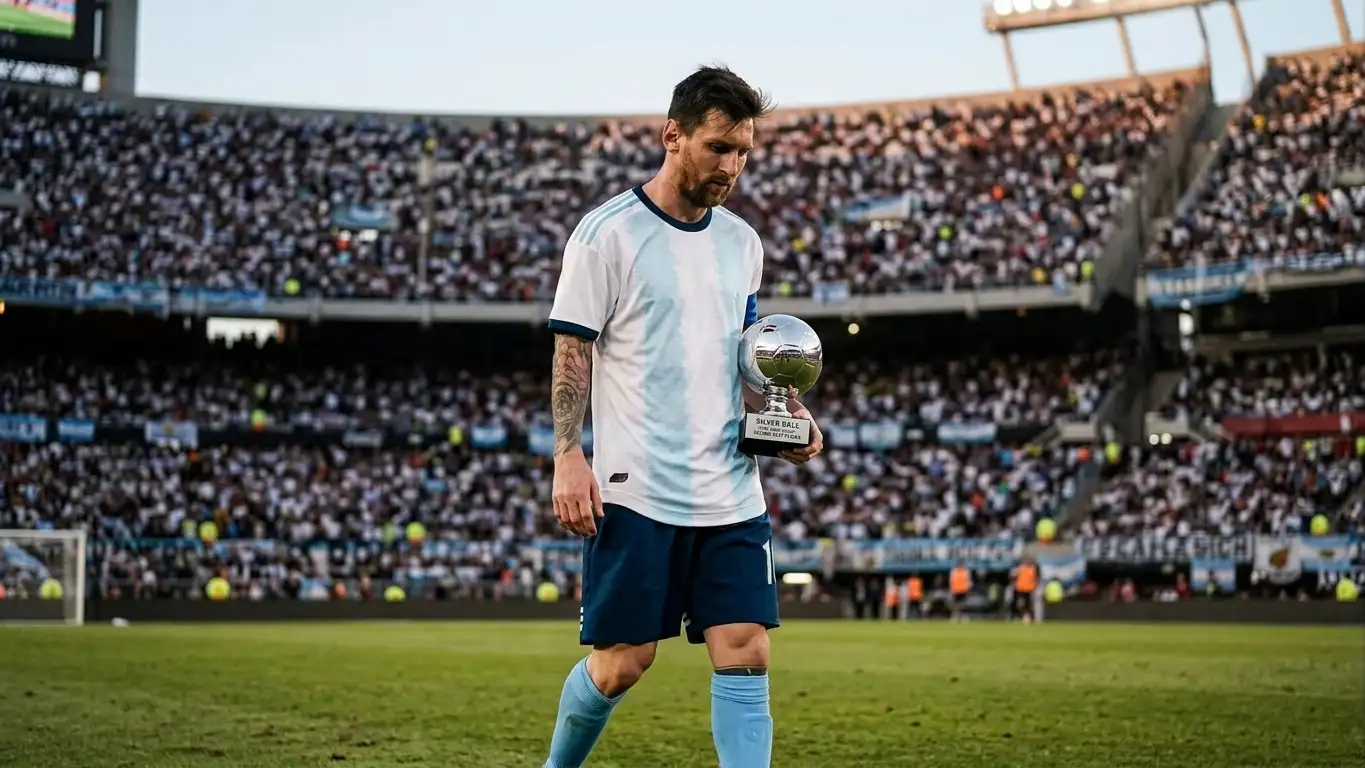
Lionel Messi walks through Spain’s guard of honour at the 2026 World Cup final medal ceremony, holding the Silver Ball after Argentina’s 1-0 defeat
Eight Goals, Four Assists, and a Scoreless Final
Start with what Messi actually did at this tournament, because the numbers alone describe something few 39-year-olds could manage.
He finished with eight goals and four assists across Argentina’s eight matches — second only to Kylian Mbappé’s 10 in the Golden Boot race, and enough to make him the pre-final favourite for the tournament’s top individual honour. His semi-final performance against England was the peak: goals that briefly took him to 21 career World Cup goals and, for a few days, the all-time record.
Through the group stage and four knockout rounds, Messi was Argentina’s talisman, their primary creator, and their most dangerous finisher. He carried the double burden of being the defending champion and the tournament’s biggest name, and for seven matches it held.
Then came the final.
Spain’s system — built around Rodri’s control of the middle and a back line that had conceded one goal in seven matches — suffocated Argentina for 120 minutes. Messi registered nothing. Argentina managed zero shots on target across the entire final, a statistic that says more about the collective than about him. But when the world’s greatest player doesn’t score in the world’s biggest match, the spotlight falls on him alone.
"I feel sad, but I am aware that we played our hearts out," Messi said after the match. "They were better, to be honest. We lost the game, and we accept that. That doesn’t mean that we will forget everything we’ve done so far, so I’d like to thank my people, my players and the country."
He thanked his players. At 39, in his last World Cup, Messi was still the captain, still taking responsibility for a team effort that fell short.
The Records He Lost — and the Ones He Kept
The final was cruel to Messi beyond the scoreline. He went into it with two things within reach: the Golden Ball, which the market had him winning at approximately 1.11 (closing price, July 19, 2026, before kickoff), and the all-time World Cup goals record, which he had briefly held at 21.
By the end of the medal ceremony, both were gone.
The Golden Ball went to Spain’s Rodri — a midfielder who hadn’t scored all tournament but had controlled every match Spain played. It was the biggest individual award upset of the tournament, and it left Messi with a Silver Ball that felt closer to condolence than celebration.
The goals record went to Kylian Mbappé, who scored twice in France’s 6-4 bronze-match defeat to England on July 18 to reach 22 career goals. Messi needed one in the final to draw level. Spain didn’t allow it. The record he had held for less than a week was gone for good.
What he keeps are records that may stand for a very long time:
- Most World Cup appearances: 33
- Most World Cup assists: 12 — the all-time career record, past Pelé’s 10
- Most World Cup minutes played of any player in the tournament’s history
He also leaves as a World Cup winner, which is the thing he spent his career being told he lacked. The 2022 title settled that argument permanently, and no result in New Jersey unsettles it.
But here’s the painful part: nobody remembers a Silver Ball. They remember the Golden Ball that got away, and the final he couldn’t win.
The Market That Crowned Him Early
Before kickoff on July 19, the betting markets had effectively handed Messi the Golden Ball. He traded at approximately 1.11 — a price implying better than 90% certainty, the kind reserved for outcomes that feel already decided.
The reasoning wasn’t stupid. Eight goals, four assists, captain of the defending champions, playing his last World Cup at 39. The narrative was too neat to resist: the farewell Golden Ball on the way to back-to-back titles.
Then the final happened. Messi was held scoreless. Argentina were outplayed. And the voters chose Rodri — the midfielder who had controlled eight matches from deep and returned from a ruptured ACL to do it.
At 1.11, backers were risking C$900 to make C$100, and it lost. That’s the trap in a market this short: the price offers almost nothing on the upside while carrying the full downside, and it was built on a story rather than on how the award is actually decided. The full settlement is in our World Cup 2026 betting markets review.
What the Loss Means for Argentina and Scaloni
Argentina’s defeat denied them the chance to become the first team since Brazil in 1958 and 1962 to win back-to-back World Cups. They came close: seven wins from seven matches, then 120 scoreless minutes against a side that conceded once in the entire tournament.
Head coach Lionel Scaloni, who led Argentina to the 2022 title, stays in charge. Whether Messi is there with him is the open question — and by 2030 he would be 43, which for an attacking player who lives on acceleration and close control makes another tournament very unlikely.
"He’s 39 years old, it’s an incredible thing," Scaloni said of Messi after the final. "In my opinion, he’s the best footballer to ever step onto a football pitch."
The present tense — "he’s the best" — suggests Scaloni thinks Messi still has something to give Argentina. The World Cup stage, though, is almost certainly closed.
The Guard of Honour Argentina Didn’t Return
One of the uglier moments of the aftermath came at the ceremony itself. Spain’s players formed a guard of honour for Messi as he collected the Silver Ball. When Spain went up to lift the trophy minutes later, Argentina’s squad turned away. No guard of honour in return.
It was a small thing that drew immediate criticism, and it came on top of a genuinely ugly post-match scene: Leandro Paredes grabbed Spain’s Eric García by the throat seconds after the whistle, with Spain’s players intervening. Media reports described Paredes as being sent off; FIFA’s official match report says he was not.
For Messi, who accepted Spain’s gesture with grace, the contrast was stark. He remained the professional even when the emotions around him didn’t.
Messi’s World Cup Legacy
So how does the career read now that it’s finished?
Six tournaments — 2006, 2010, 2014, 2018, 2022 and 2026 — 33 matches, 21 goals, 12 assists, one world title, one Golden Ball, one Silver Ball. Nobody has played more World Cup football, and nobody has created more goals in it.
It’s a record that includes the thing he was told for fifteen years he would never have: a World Cup. He won it in 2022, and 2026 was the attempt to do it twice — the harder ask, the one only Italy and Brazil have ever managed.
He didn’t get it. He ran into a Spain team that conceded one goal in eight matches and set a new international record of 38 games unbeaten along the way. That’s not a failure of Messi. That’s an opponent who was better than everyone, all tournament, including the best player of his generation. The full story of how they did it is in our World Cup 2026 final wrap.
The 2026 final didn’t diminish him. It just reminded us that the greatest player in the world is still subject to the cruelties of knockout football.
Where Canadian Bettors Find Value in Player Markets
Award and player markets are where narrative distorts pricing most — Messi at 1.11 is the cleanest example the tournament produced. If you’re working out how those markets are priced, start with our World Cup betting markets explainer and the World Cup 2026 odds board.
Canadian options for tournament MVP and top-scorer markets:
- Boomerang Bet.io – Offers early Golden Ball and Golden Boot markets
- LamaBet – Features veteran-player and tournament-milestone props
- WinRolla – Provides awards markets that update as a tournament progresses
Always bet responsibly. Set limits before placing wagers, and only bet what you can afford to lose. If you or someone you know needs help, contact ConnexOntario at 1-866-531-2600.
