
Spain at World Cup 2026: La Roja’s Quest for Global Dominance
 Available in US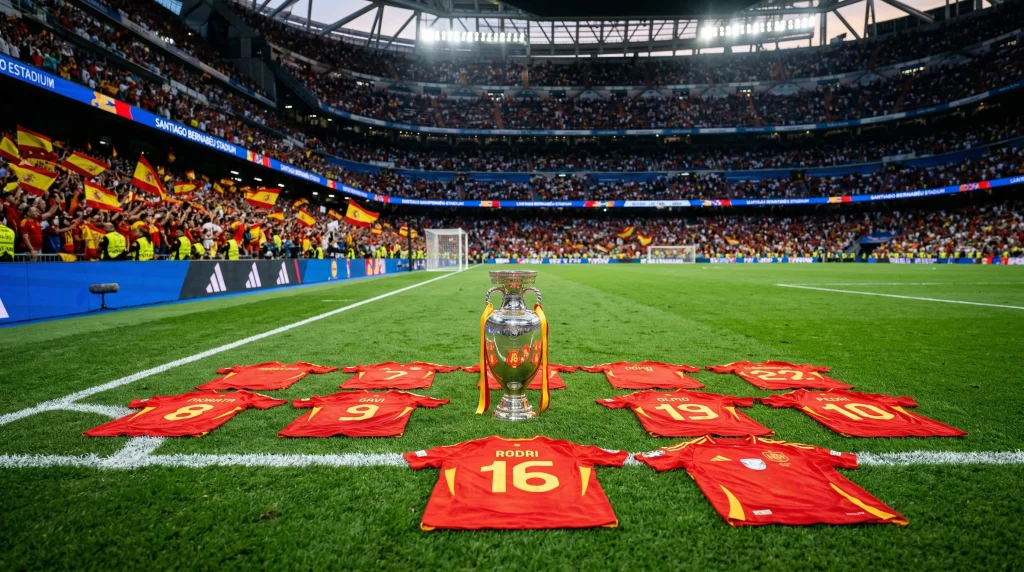
Table of Contents
The Berlin night still echoes. July 14, 2024 — Spain dismantled England 2-1 in the European Championship final, capping an unbeaten tournament run that announced a new era of Spanish dominance. Lamine Yamal, just 17 years old, had already terrorized defenders across Germany. Rodri orchestrated midfield control with the precision of a surgeon. And Luis de la Fuente, once dismissed as an uninspired appointment, had constructed something that felt inevitable.
Spain World Cup 2026 arrives with momentum that no other contender can match. The Euro 2024 triumph wasn’t a scrappy victory earned through defensive resilience or penalty shootout luck. La Roja attacked relentlessly, scored freely, and imposed their identity on every opponent. They’re not merely favorites for the World Cup; they’re the benchmark against which every other squad measures itself.
I’ve analyzed enough tournaments to recognize the difference between pretenders and genuine champions. Spain possesses something that transcends tactics — a collective belief forged through recent success. When Yamal receives the ball in the final third, defenders already know what’s coming. They just can’t stop it.
Perfect Qualifiers: Spain’s Path to America
Qualifying campaigns often reveal more about a team’s depth than their starting eleven. Spain’s European qualification group presented modest opposition — Scotland, Norway, Georgia, and Cyprus — but La Roja treated every fixture with the intensity of a knockout match. Eight wins from eight games, 28 goals scored, just 4 conceded. The numbers reflect efficiency that bordered on mechanical.
What impressed me most wasn’t the victories themselves but the manner of achieving them. Against Scotland at Hampden Park, Spain weathered early physicality before asserting control through Rodri’s midfield dominance. In the away fixture against Norway, they neutralized Erling Haaland’s threat through disciplined defensive positioning while exploiting space behind the Norwegian full-backs. Each match served as a tactical exercise, with De la Fuente refining approaches that translate directly to World Cup knockout situations.
The qualification period also provided runway for integration. Younger players like Pau Cubarsí earned minutes alongside established stars, building cohesion that tournament compression doesn’t allow. By the time World Cup preparation begins, Spain’s squad will have spent two full years developing shared understanding under the current system. That continuity matters when margins shrink in elimination matches.
Spain’s goal difference during qualifying (+24) led all European qualifiers, suggesting both offensive potency and defensive reliability. They didn’t merely beat opponents; they suffocated them through possession dominance and clinical finishing. Average possession figures exceeded 65% across the campaign — a testament to the tiki-taka evolution that De la Fuente has refined rather than abandoned.
The rotation policy during qualification also merits attention. De la Fuente managed minutes intelligently, preventing burnout among key players while testing depth options under competitive conditions. This squad management creates advantages during the World Cup’s compressed schedule, where recovery time between matches diminishes as the tournament progresses. Players who enter rested outperform those carrying fatigue from excessive workloads.
The Squad: La Roja’s Brilliant Generation
Depth charts frustrate me when they reduce dynamic squads to static hierarchies. Spain’s roster doesn’t work that way. The 23-26 players De la Fuente selects will function as a collective organism, with tactical adjustments determining who starts rather than rigid positional preferences. That flexibility represents Spain’s greatest structural advantage over more predictable opponents.
In goal, Unai Simón has grown into the role that previous Spanish goalkeepers owned through reputation rather than performance. His distribution initiates attacks from the back, and his shot-stopping has reached elite levels over the past two seasons. The backup options provide quality insurance without creating selection controversy.
The defensive line blends experience with emerging talent. Dani Carvajal’s right-back position seems secure despite his age — his tournament experience and tactical intelligence remain unmatched. On the left, younger options compete for minutes behind an established starter. The center-back partnership will likely feature Aymeric Laporte alongside one of several options, with Pau Cubarsí pushing for inclusion despite his youth.
Midfield is where Spain separates from competitors. Rodri anchors the triangle, but the options around him create selection dilemmas that managers dream about. Pedri’s technical brilliance, Gavi’s tenacity, Fabián Ruiz’s goal threat — each offers something distinct, and all three can start simultaneously in certain formations. This embarrassment of riches allows De la Fuente to tailor his midfield profile to specific opponents.
The attacking positions feature the genuine superstar quality that World Cup champions require. Lamine Yamal’s emergence accelerated timelines that scouts had projected years into the future. His ability to beat defenders one-on-one, combined with end product that belies his teenage years, transforms Spain’s right flank into a constant threat. On the opposite side and through the middle, additional options provide variety without sacrificing quality.
Lamine Yamal: The Teenage Sensation
Comparing teenagers to established legends typically invites ridicule. I’ve seen countless “next Maradona” and “new Messi” labels attached to players who never approached those heights. Lamine Yamal deserves different treatment — not because he’s reached legendary status, but because his current production already exceeds what most wingers achieve in their prime years.
At Euro 2024, Yamal became the youngest player to appear in a European Championship final. He also became the youngest goalscorer in tournament history with his curling strike against France in the semi-final. These aren’t participation trophies; they’re evidence of decisive performance in matches that defined Spain’s path to the title. When the pressure intensified, Yamal elevated rather than wilted.
His technical profile combines skills that rarely coexist. The close control and quick feet suggest a player built for tight spaces, yet his acceleration allows him to stretch defenses in transition. He can beat defenders inside or outside, shoot from distance or create for teammates, and maintain concentration across 90 minutes despite the physical attention he receives. The complete package at 18 years old during World Cup 2026.
Defensively, Yamal has grown under Barcelona and Spain’s tactical demands. He tracks back when required, applies pressure in coordinated sequences, and rarely leaves his full-back exposed. This two-way contribution distinguishes him from wingers who offer attacking brilliance but liability without the ball. De la Fuente can trust Yamal to fulfill his responsibilities on both sides of possession.
Rodri: The Midfield Metronome
Every championship team requires a player who controls tempo. For Spain, that player is Rodri — Manchester City’s midfield anchor and the reigning Ballon d’Or winner. His presence transforms matches through anticipation rather than intervention, positioning himself to intercept danger before it materializes and recycling possession with metronomic reliability.
Rodri’s passing statistics tell one story: completion rates exceeding 90%, progressive passing distance among the highest in world football, and a ratio of ball losses to touches that suggests almost flawless retention. But numbers can’t capture how he shapes the space around him. Opponents know where Rodri is; they just can’t access the areas he occupies.
His recovery from the ACL injury suffered in September 2024 represents the primary concern heading into World Cup 2026. Ligament reconstructions require 9-12 months of rehabilitation before return to competition. The timeline suggests Rodri should be available for the tournament, but questions about match sharpness and confidence in explosive movements will linger until he demonstrates full fitness through extended playing time. De la Fuente’s contingency plans account for scenarios where Rodri’s availability remains uncertain.
The Barcelona Core
Barcelona’s La Masia academy has produced Spanish internationals for decades, but the current generation represents perhaps the richest harvest yet. Pedri, Gavi, Lamine Yamal, and Pau Cubarsí all developed through the same youth system, share tactical vocabulary from their club environment, and bring that synergy directly into the national team setup.
This Barcelona foundation provides Spain with built-in chemistry that other national teams cannot replicate. When Pedri receives possession and looks to combine, Yamal and Gavi anticipate his intentions without verbal communication. The patterns they execute at club level transfer seamlessly to international football, reducing the adjustment period that typically hampers national team cohesion during tournament preparation.
The risk involves dependency on a single club’s system. If Barcelona struggles tactically during the 2025-26 season, rust could infect the Spanish core. De la Fuente mitigates this by integrating players from other clubs — Rodri from Manchester City, Carvajal from Real Madrid — who offer alternative perspectives and prevent insularity from limiting Spain’s adaptability.
Tactical DNA: Luis de la Fuente’s Vision
The tiki-taka debates grew tiresome years ago. Spain’s ball-dominant approach outlived its effectiveness when opponents learned to defend with disciplined low blocks, denying space and frustrating possession into sideways passing. De la Fuente understood this limitation and evolved the system without abandoning its core principles.
Current Spain attacks with greater verticality than the Xavi-Iniesta era squads. Possession remains important, but it serves as a means to create penetration rather than an end in itself. When opportunities to play forward exist, Spanish midfielders take them immediately rather than recycling to maintain control. This directness catches opponents expecting patient build-up.
The pressing structure has also intensified. Spain now win possession in the opposition half more frequently than during previous cycles, forcing turnovers in dangerous areas and shortening the distance to goal. Yamal and the opposite winger initiate pressure on opposing full-backs, while the midfield triangle compacts to cut passing lanes through central areas. This aggressive approach demands fitness levels that Spain’s squad possesses through club-level conditioning.
Defensively, Spain operate higher than most elite teams, trusting their center-backs to handle situations in space rather than retreating to protect the penalty area. This approach requires exceptional defensive reading and recovery speed, which the current personnel provide. The tradeoff involves vulnerability to balls over the top, which opponents have occasionally exploited — a concern that De la Fuente addresses through specific tactical adjustments against teams with athletic forwards.
Set pieces under De la Fuente have improved markedly from previous Spanish iterations. Both attacking and defending set plays receive focused attention during training camps, with varied delivery patterns and zonal marking adjustments that maximize Spain’s aerial presence. While not traditionally considered a set-piece team, La Roja now threatens from corners and free kicks with regularity — adding another dimension to their already formidable attack.
Group H Analysis: Uruguay, Saudi Arabia, Cape Verde
The draw could hardly have been kinder. Group H places Spain alongside Uruguay — a respectable opponent — while Saudi Arabia and Cape Verde represent significant quality gaps that La Roja should exploit comfortably. Advancement is not merely expected; it’s demanded by anyone assessing the relative strengths objectively.
Uruguay presents the only serious group-stage challenge. Their two World Cup titles may be historical artifacts at this point, but the competitive DNA persists. Darwin Núñez and Federico Valverde represent genuine quality, and Uruguay’s physical approach can disrupt teams that prefer technical superiority. Spain will need to manage tempo against Uruguayan pressing while exploiting the space that their aggression creates. The tactical battle between Spain’s positional play and Uruguay’s high-intensity pressing represents the marquee group-stage fixture — a match that could determine seeding for the knockout rounds.
Saudi Arabia arrives with memories of their Argentina shock from 2022, when they defeated the eventual champions 2-1 in the group stage. That result, however, represented an aberration rather than a sustainable level. Saudi players lack European club experience, limiting their exposure to the intensity that World Cup knockout football demands. Spain should control possession extensively and convert opportunities with efficiency.
Cape Verde marks their World Cup debut, achieving qualification through the expanded 48-team format. Their squad features several players with Portuguese league experience, but the gap in overall quality between Cape Verde and elite European nations remains vast. Spain will treat this fixture as rotation opportunity, resting key players while still securing maximum points.
The scheduling of Group H fixtures works in Spain’s favor. Their opening match against a lesser opponent allows for rhythm-building before the Uruguay test. The final group match, likely with qualification already secured, permits lineup experimentation and strategic rest. This structure mirrors Spain’s Euro 2024 group stage management, where De la Fuente prioritized knockout-round readiness over group-stage heroics.
Projected Path: From Group to Final
Spain’s bracket position creates a favorable knockout route. Winning Group H likely leads to Round of 32 matches against third-placed qualifiers from weaker groups. From there, the path to the quarter-finals avoids other top-seeded nations, allowing Spain to build momentum without facing fellow favorites until the tournament’s later stages.
The semi-final and final opponents depend on results elsewhere, but Spain’s route could delay encounters with England, France, and Brazil until the absolute final matches. This seeding advantage matters more in expanded 48-team formats, where the bracket possibilities multiply. De la Fuente’s squad preparation accounts for various scenarios, but the baseline expectation involves reaching at least the quarter-finals without maximum exertion.
Historical precedent supports Spanish deep runs. Since winning the 2010 World Cup, Spain has reached the knockout stages consistently despite varying squad quality. The current generation surpasses several of those transitional teams in talent concentration and tactical coherence. Anything less than a semi-final appearance would constitute underachievement relative to squad capability.
The physical demands of tournament football also favor Spain. Their possession-based approach reduces defensive actions per match, limiting the accumulated fatigue that plagues teams relying on counter-attacking intensity. When Spain controls 60-70% of possession, their opponents run more and defend longer — a differential that compounds across multiple fixtures. By the quarter-finals, teams that fought through physical group stages often lack the freshness to compete with La Roja’s relentless pressing.
Betting on Spain: The Favorite’s Burden
Backing favorites rarely offers the value that successful betting requires. Spain’s World Cup 2026 odds around +450 reflect their status as the consensus top choice — short enough to suggest probability, but not so short that the implied chance exceeds realistic assessment. The question becomes whether +450 accurately prices Spain’s true championship likelihood.
My analysis suggests Spain’s actual probability of winning the tournament sits around 18-20%, which translates to fair odds of +455 to +455. At +450, there’s minimal edge in the outright market. The value lies elsewhere — in advancement propositions, group stage outcomes, and player markets where bookmakers may have mispriced specific scenarios.
Spain to win Group H should price around -350 based on their quality advantage over Uruguay, Saudi Arabia, and Cape Verde. If markets offer anything more generous, the edge exists. Similarly, Spain to reach the semi-finals at approximately -150 feels reasonable given their probable bracket path, but the opportunity cost of capital tied up in heavy favorites diminishes overall portfolio efficiency.
The more interesting plays involve Spanish player markets. Lamine Yamal’s tournament goal totals, Rodri’s chances to win Player of the Tournament, and Spain’s clean sheet prop against specific opponents all offer angles where individual assessment might differ from market consensus. Yamal at +800 for Golden Boot represents long odds on a player who creates his own chances and finishes at an elite rate for his age.
Value Markets for Spain Bettors
I’m taking Spain to win Group H and Uruguay to finish second at +150 for the exact group finish. This parlay captures the most likely scenario while offering better value than backing Spain alone at heavy chalk. Uruguay’s quality should see them past Saudi Arabia and Cape Verde even if Spain defeats them head-to-head.
For individual match betting, Spain versus Uruguay presents the most actionable group fixture. The head-to-head spread likely opens around Spain -1.5, which captures my expectation that La Roja wins by multiple goals against a Uruguay side that will struggle to contain Yamal and compete in midfield against Rodri’s control. The -1.5 alternative line typically prices around +130 to +150, offering value if Spain performs to capability.
Player props merit consideration throughout Spain’s tournament. Lamine Yamal to score in any group stage match prices around -120, which I find attractive given his goalscoring form and the defensive quality he’ll face. Rodri’s assist totals also warrant attention — his progressive passing creates chances, and teammates convert at high rates.
The Crown Is Theirs to Lose
Spain enters World Cup 2026 as the team to beat. Their Euro 2024 triumph demonstrated championship quality under pressure. Their qualifying campaign confirmed consistency. And their squad depth allows tactical flexibility that reactive opponents cannot match. De la Fuente has built something that feels inexorable — a machine that processes matches with ruthless efficiency.
The favorite’s burden is real, however. Every opponent approaches Spain with maximum intensity, knowing that defeating the European champions represents a career highlight. The margins shrink when underdogs raise their performance levels, and knockout football’s single-match format allows for variance that league seasons eliminate. Spain must maintain concentration across seven matches spanning nearly six weeks.
My tournament prediction places Spain in the final, with championship probability among the highest in the field. Whether they lift the trophy depends on matchup specifics and the inevitable bounces that determine tight contests. But of the 48 teams gathering in North America this June, none arrives with better preparation, deeper talent, or more recent evidence of ability to win when it matters most.
