Germany at World Cup 2026: Die Mannschaft’s North American Revival
 Available in US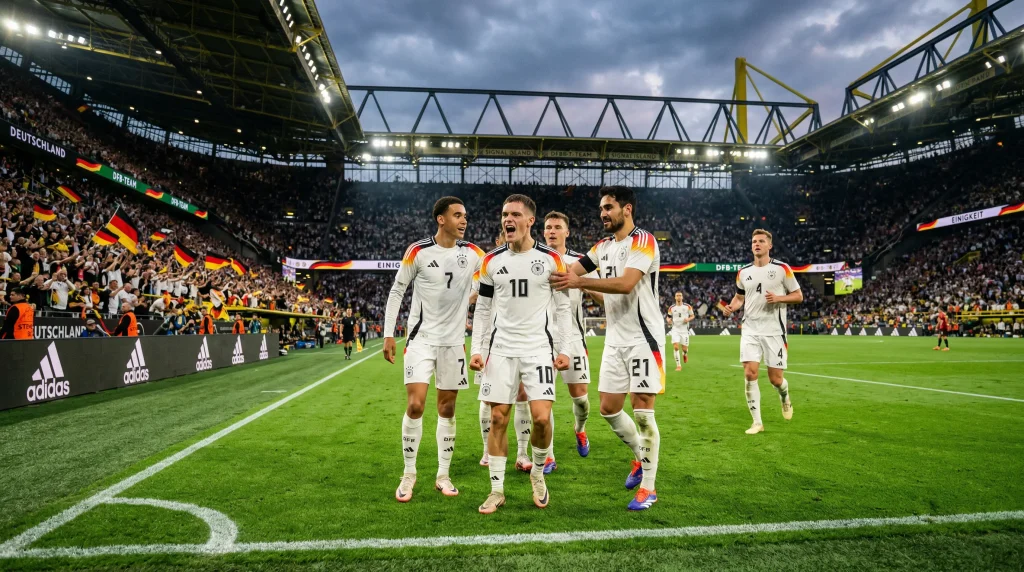
Table of Contents
Back-to-back World Cup group stage exits. For any other nation, this might represent unfortunate variance. For Germany — four-time champions, perpetual tournament contenders — 2018 and 2022 demanded reckoning. The country that built its identity on tournament success watched helplessly as Japan and South Korea exposed fundamental flaws that no amount of historical pedigree could obscure.
Germany World Cup 2026 emerges from that wreckage with something unexpected: genuine hope. The home Euro 2024, though ending in quarter-final disappointment, revealed a path forward. Florian Wirtz and Jamal Musiala announced themselves as generational talents. Julian Nagelsmann established tactical coherence that previous managers couldn’t achieve. And the infrastructure that produces German football excellence remained intact, merely waiting for personnel worthy of its standards.
I’ve tracked German tournament football through multiple cycles, and the current situation reminds me of previous German rebuilds that concluded with silverware. After the 2000 European Championship disaster, Germany restructured youth development and won the 2014 World Cup with the generation that emerged. The post-2022 reset follows similar patterns — accepting failure, identifying solutions, and executing with the ruthless efficiency that defines German approaches to complex problems.
Post-Home-Euro Momentum: Germany’s New Chapter
Euro 2024 on home soil provided the emotional and competitive foundation that World Cup 2026 builds upon. Germany opened with thrilling victories that captivated their own public, playing attacking football that recalled the 2014 triumph rather than the cautious setups that produced recent failures. Musiala’s dribbling, Wirtz’s creativity, and the collective energy reminded Germans why they once assumed tournament success as birthright.
The quarter-final exit against Spain stung precisely because it followed such promising progression. Germany matched the eventual champions for long stretches before tactical adjustments and individual moments proved decisive. The defeat revealed both the remaining gap to elite level and the pathway to closing it. Nagelsmann’s squad was competitive with the tournament’s best team — not dominant, but no longer embarrassingly inferior.
The post-Euro period focused on consolidation rather than revolution. Nagelsmann retained the core principles that produced home tournament success while addressing specific weaknesses the Spain match exposed. The goal involves evolution rather than wholesale change, building upon what works rather than abandoning progress for another tactical experiment.
The continuity under Nagelsmann provides stability that German football desperately needed. After cycling through managers who never established consistent identity, a young coach with clear vision and player trust offers something different. Whether that stability translates to World Cup success depends on continued development, but the foundation exists in ways it hasn’t for a decade.
The Struggles: Two Group Stage Exits
Explaining consecutive World Cup group stage eliminations requires uncomfortable honesty. The 2018 defending champions arrived in Russia complacent, assuming their title credentials would manifest without the hunger that originally earned them. Mexico’s opening victory exposed German arrogance; South Korea’s stoppage-time goals merely confirmed what the tournament had already revealed.
Four years later in Qatar, different players made similar mistakes. Japan’s comeback victory in the opening match — surrendering a lead through defensive disorganization — created pressure that Germany couldn’t escape. Even victory against Spain proved insufficient when Costa Rica and Japan combined in the final group matches to eliminate Die Mannschaft on goal difference.
The common thread involved mental fragility when circumstances deviated from expectations. German teams that won tournaments had recovered from setbacks with determination; recent German teams crumbled. This psychological dimension required attention beyond tactical adjustments or personnel changes. The culture itself needed reset.
Nagelsmann’s approach addresses these psychological factors directly. His communication style, his expectations for mental preparation, and his squad selection criteria all prioritize resilience alongside technical ability. Players who’ve demonstrated tournament-level mentality receive preference over more talented alternatives who’ve struggled under pressure. The balance between ability and character shifts toward character when choices become necessary.
The integration of sports psychology resources into German national team preparation reflects this renewed emphasis on mental strength. Players work with specialists who address pressure management, focus maintenance, and recovery from setbacks. These interventions attempt to build psychological resilience that previous German squads assumed would emerge naturally from quality. The explicit attention signals acknowledgment that mental preparation requires deliberate cultivation.
German Qualifiers: Signs of Revival
European qualification for World Cup 2026 confirmed German recovery without fully testing their championship credentials. The group featured Hungary, Netherlands, Bosnia and Herzegovina, and minnows — competitive enough to require professional effort, insufficient to challenge maximum German performance. Eight wins and comfortable margins suggested normalization rather than exceptional form.
The Netherlands matches provided the most useful data points. Both fixtures featured high-level competition against a tactical opponent with individual quality. Germany’s performances demonstrated the pressing intensity, attacking combinations, and defensive organization that Nagelsmann demands. These results established baseline competence against European elite that recent German teams couldn’t guarantee.
What qualifying couldn’t provide was knockout-round pressure simulation. The expanded World Cup format means Germany likely faces Round of 32 opponents before genuinely challenging tests arrive. Whether the team that performed impressively in qualifying maintains composure when elimination looms remains the fundamental uncertainty.
The integration of younger players during qualification built depth that tournament football demands. Beyond Wirtz and Musiala, additional options developed through competitive minutes that friendly matches cannot replicate. This depth provides insurance against injury or suspension while maintaining quality levels that previous German squads couldn’t sustain across extended campaigns.
Squad Analysis: Experience Meets Youth
German squad construction for World Cup 2026 reflects the transition between eras. Remnants of the 2014 World Cup winning squad provide experience and standards, while the emerging generation provides the energy and technical quality that modern tournament football requires. The blend creates potential synergy if managed correctly — or generational friction if communication fails.
Goalkeeping features Manuel Neuer’s continued presence, assuming his fitness holds through another tournament cycle. His sweeper-keeper style transformed the position globally, and his tournament experience provides irreplaceable value in pressure moments. The backup options have developed through Bundesliga competition, ready to step in if Neuer’s age or injury create necessity.
Defensive personnel has stabilized after the uncertainty that plagued recent tournaments. Center-back partnerships now feature understanding developed through extended minutes together. Full-back positions combine attacking intent with defensive awareness that previous German setups sometimes sacrificed. The overall defensive age profile suggests players entering peak years rather than managing decline.
Midfield construction centers on the Wirtz-Musiala axis that captured Euro 2024 imaginations. Their creative interplay creates chances that straightforward systems cannot generate. The supporting midfield options provide different profiles — more defensive, more physical, more progressive — that allow tactical adjustments without sacrificing overall quality.
Florian Wirtz and Jamal Musiala
The partnership that defines German football’s present and future operates through complementary strengths rather than redundancy. Wirtz’s left-footed creativity from right-sided positions combines with Musiala’s dribbling wizardry through central areas. Defenders cannot focus on one without the other exploiting created space. This dual threat amplifies each player’s individual danger.
Wirtz’s development at Bayer Leverkusen accelerated beyond projections that seemed ambitious at the time. His passing range, shooting accuracy, and positional intelligence suggest someone years beyond his actual age. The Bundesliga’s tactical demands refined abilities that raw talent alone couldn’t polish. By World Cup 2026, Wirtz enters the period where potential becomes proven production.
Musiala’s Bayern Munich pathway provided different developmental challenges. Playing alongside — and eventually replacing — established stars required earning trust through performance rather than potential. His ability to receive possession in tight spaces, turn defenders, and advance through crowded areas creates opportunities that few players in world football can replicate. The skill set resists tactical counters because it operates through individual brilliance rather than pattern exploitation.
Together, they represent the best German creative partnership since Müller and Özil peaked during the 2014 tournament. The comparison invites pressure that could burden lesser players, but both Wirtz and Musiala have demonstrated composure under expectation. Euro 2024 didn’t overwhelm them; it showcased them. World Cup 2026 provides the larger stage that their talents deserve.
The Experienced Core
Beyond the youthful creativity, German squad construction maintains experienced players who provide stability and standards. Their tournament memories — both triumphs and failures — inform preparation in ways that cannot be communicated abstractly. They’ve felt the pressure that World Cup football generates; they can guide younger teammates through that environment.
Joshua Kimmich’s positional versatility allows deployment in multiple configurations. His progression from right-back to central midfield reflects development that coaches value: a player who absorbs new responsibilities while maintaining previous capabilities. The tactical options Kimmich creates give Nagelsmann flexibility that rigid specialists cannot provide.
The Bayern Munich core provides club-level understanding that translates to international cohesion. Players who train together daily, who compete for domestic honors together, bring automatic chemistry to national team environments. This built-in relationship reduces the adjustment periods that international camps sometimes require.
Julian Nagelsmann’s Project
The youngest manager ever appointed to lead the German national team, Nagelsmann brought fresh perspective to an environment calcified by tradition and recent failure. His tactical innovations at Hoffenheim, Leipzig, and Bayern Munich demonstrated willingness to challenge conventional wisdom. That iconoclastic approach now shapes German national team football.
The pressing system Nagelsmann implements demands athletic capacity that previous German squads sometimes lacked. The high-energy sequences require fitness levels maintained through rigorous physical preparation. Players who cannot sustain pressing intensity find reduced roles regardless of technical ability. This physical demand influences squad selection toward athletes who happen to be talented rather than talents who happen to be athletes.
Attacking patterns under Nagelsmann prioritize verticality over patient circulation. When opportunities to penetrate appear, German players take them immediately rather than recycling possession. This directness catches opponents expecting the methodical build-up that German football traditionally employed. The unpredictability creates chances that system-dependent teams cannot generate.
The relationship between Nagelsmann and his players reflects modern coaching evolution. He communicates as peer rather than authority figure, earning respect through tactical competence rather than demanding it through hierarchical position. This collaborative approach maximizes input from experienced players while maintaining clear coaching direction. The balance suits the current squad’s composition of veterans and emerging stars.
Set-piece organization has received particular attention under Nagelsmann’s coaching staff. Both attacking routines and defensive assignments feature coordination that previous German setups sometimes neglected. The height advantage that German squads typically possess translates more consistently to scoring opportunities when practiced patterns execute correctly. Dead-ball situations provide goal-scoring avenues beyond open play that pragmatic tournament football often requires.
Group E Analysis: Ecuador, Ivory Coast, Curaçao
Germany’s group draw provided favorable conditions for advancement without completely avoiding competitive opposition. Ecuador represents South American quality that can trouble unprepared European opponents. Ivory Coast arrives as AFCON 2023 champions with genuine individual talents. Curaçao participates as tournament debutants whose presence reflects expansion rather than competitive threat.
Ecuador’s tactical sophistication has improved substantially through recent cycles. Their defensive organization and counter-attacking threat troubled opponents throughout qualification and previous tournaments. Germany must manage tempo against Ecuadorian pressing while exploiting the space that their aggression creates. The stylistic matchup favors German quality but requires professional execution rather than assumed superiority.
Ivory Coast’s continental championship confirms quality that reaches beyond Africa. Their midfield options compete at elite European clubs, bringing tactical awareness that matches German preparation standards. The physical profile Ivory Coast presents — pace, power, aerial ability — creates matchup challenges that technical superiority alone cannot solve. Germany must balance patient build-up with quick transitions that exploit Ivorian forward commitment.
Curaçao makes their World Cup debut through the expanded 48-team format. Their squad draws from Dutch lower leagues and Caribbean competition, creating substantial quality gap relative to Group E favorites. Germany should rotate freely against Curaçao, preserving fitness for knockout rounds while still securing comfortable victory through depth options.
The scheduling of Group E fixtures benefits German preparation strategy. Opening against a manageable opponent allows for rhythm establishment before facing Ivory Coast’s physical challenge. The final group match positioning permits lineup decisions based on already-secured qualification. This structure mirrors successful tournament campaigns where early momentum compounds through progressive stages.
Tournament Pedigree: Four-Time Champions
Germany’s World Cup history establishes expectations that few nations share. Four titles — 1954, 1974, 1990, 2014 — distributed across eras demonstrate sustained excellence rather than isolated achievement. The German system produces championship teams because the infrastructure, the culture, and the development pathways combine to create sustainable success.
The recent failures disturbed this narrative without destroying its foundation. The youth academies that produced 2014 winners continue operating. The Bundesliga’s competitive quality maintains player development standards. The coaching education that Germany pioneered remains world-leading. What failed was application of these resources rather than the resources themselves.
World Cup 2026 tests whether the correction suffices. The talent pipeline has delivered Wirtz, Musiala, and additional prospects. The coaching appointment has provided stability and vision. The squad composition blends experience with emergence. Every ingredient for German revival exists; the recipe’s execution determines whether revival becomes reality.
Germany Odds: Comeback Value?
Current World Cup 2026 odds place Germany around +1200, reflecting both the talent level and the skepticism that recent failures generated. This pricing positions Germany behind the primary favorites while acknowledging the upside that Wirtz and Musiala provide. The market essentially asks: has Germany actually fixed what was broken, or do structural problems persist beneath surface improvement?
My assessment places Germany’s actual championship probability around 7-9%, translating to fair odds between +1010 and +1330. At +1200, you’re getting approximately fair value with slight potential edge depending on which end of the probability range proves accurate. The uncertainty creates opportunity for those confident in German bounce-back.
Group E advancement should price around -600 based on the quality differential between Germany and their opponents. Ivory Coast complicates certainty slightly, but Germany should accumulate sufficient points across three matches. Germany to win Group E at approximately -200 captures the expectation that maximum points arrives despite Ivorian and Ecuadorian resistance.
Value Bets for Germany
I’m taking Germany to reach the quarter-finals at approximately +120 as my primary position. The Group E path should produce comfortable advancement, and the Round of 32 opponent will likely come from a weaker group. The quarter-final test represents where German quality meets genuine resistance — far enough to generate reasonable return, close enough to reflect realistic expectation.
For group-stage betting, Germany to win all three matches at +150 offers attractive value. Ecuador and Ivory Coast present challenges but not quality levels that should defeat German intensity. The third match against Curaçao allows potential rotation while still securing victory. Maximum points from Group E seems achievable given the talent differential.
Wirtz and Musiala’s combined goal involvement deserves attention in player markets. Their chances created, expected assists, and goal-scoring opportunities should accumulate across group fixtures. Taking both players’ over totals on assists or combined goal involvement captures the expectation that German attack flows primarily through their creativity.
The German Machine Rebuilds
Germany enters World Cup 2026 at a fascinating inflection point. The failures of 2018 and 2022 demanded restructuring that Euro 2024 began validating. The youth revolution led by Wirtz and Musiala provides attacking quality that Germany hasn’t possessed since the 2014 generation peaked. And the continuity under Nagelsmann offers stability that previous coaching carousels denied.
The question involves whether recovery has progressed sufficiently to contend for the trophy or merely escape embarrassing early exits. My assessment falls somewhere between those extremes — Germany should reach knockout rounds comfortably and compete in quarter-final or semi-final matches. Championship seems possible but not probable given the quality of Spain, England, and France.
What seems certain is that Germany has moved beyond the nadir that produced those group-stage eliminations. The machine that produces German football excellence continues operating. The inputs have improved. The outputs should follow. Whether 2026 delivers silverware or merely respectability, my tournament prediction places them among the contending nations once again.
