
Argentina at World Cup 2026: Defending Champions’ Final Dance
 Available in US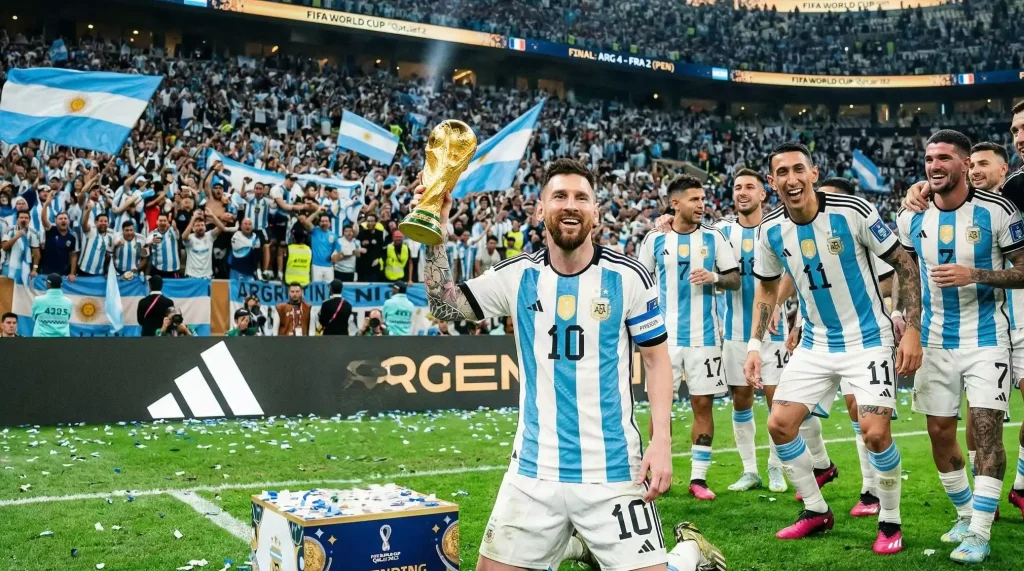
Table of Contents
Eighteen million people flooded the streets of Buenos Aires. The parade that never ended. Lionel Messi, draped in the bisht, cradling the trophy that had eluded him for 16 years. December 2022 delivered the coronation that football demanded — the greatest player of his generation, perhaps any generation, finally achieving the only prize that mattered.
Argentina World Cup 2026 arrives with a question that no defending champion wants to answer: what comes next? The emotional narrative has concluded. The Hollywood ending has been written. Now La Albiceleste must prove that Qatar wasn’t merely Messi’s personal triumph but the foundation for sustained Argentine dominance on football’s biggest stage.
I’ve analyzed every World Cup since 2006, and the defending champion’s curse is real. No nation has successfully defended the title since Brazil in 1962. Germany exited in the group stage in 2018. France lost the final in 2022 after winning in 2018. The historical pattern suggests Argentina faces headwinds that transcend squad quality. But this Argentina team has already defied history once. They might just do it again.
From Qatar Glory to North American Defense
The 2022 triumph created expectations that subsequent performances struggle to satisfy. Every match since has invited comparisons to that perfect tournament run — the nervous opening loss to Saudi Arabia, the recovery against Mexico, the knockout dominance culminating in the greatest World Cup final ever played. Matching that emotional intensity across another seven-match campaign seems impossible by definition.
Argentina’s post-World Cup trajectory confirmed their quality extends beyond one magical month. Copa América 2024 delivered another trophy, maintaining the unbeaten run that stretches back to 2019. The CONMEBOL World Cup qualifiers, traditionally competitive affairs featuring altitude challenges and intense atmospheres, proceeded without Argentina suffering defeat. This sustained excellence suggests structural strength rather than tournament-specific variance.
The key personnel from 2022 remain available for 2026. Emiliano Martínez’s goalkeeping brilliance, including his penalty-saving heroics, continues to anchor the defensive structure. Enzo Fernández’s midfield emergence has only accelerated through Chelsea experience despite inconsistent club form. And Messi — 38 years old in June 2026 — reportedly remains committed to one final World Cup appearance before international retirement.
Lionel Scaloni’s management deserves credit for maintaining squad harmony through the post-victory period. Championship teams often splinter as egos inflate and external opportunities multiply. Argentina has avoided those pitfalls, preserving the collective spirit that distinguished them in Qatar. Players who sacrificed individual glory for team success maintain that orientation, creating continuity that championship defense requires.
The Messi Question: One Last World Cup?
Every Argentina analysis inevitably orbits the same celestial body. Messi’s status for World Cup 2026 determines Argentine expectations more than any tactical consideration or squad depth discussion. His presence transforms a good team into championship contenders; his absence reduces Argentina to merely competitive.
At 38 years old, Messi will have adapted his game to physical limitations that age imposes on even transcendent talents. The explosive dribbling that defined his Barcelona peak has already given way to more economical movement and devastating efficiency in final-third decisions. He no longer beats defenders through acceleration; he beats them through positioning, timing, and the accumulated wisdom of 20 years at the highest level.
The MLS chapter at Inter Miami has attracted criticism from those who view American football as retirement league football. That characterization ignores the strategic value of reduced physical demands that preserve Messi’s body for international competitions. He can rest between matches, manage training loads, and arrive at World Cup 2026 fresher than he would following another grueling European club season.
Messi’s public statements have consistently indicated World Cup 2026 represents his final international tournament. The farewell tour aspect adds emotional weight that could enhance or burden performance. In 2022, similar pressure seemed overwhelming — and Messi delivered the defining performance of his career. The precedent suggests he elevates rather than crumbles under expectation’s weight.
South American Qualifiers: The Champions’ Campaign
CONMEBOL qualification for World Cup 2026 proceeded without significant drama for Argentina. The expanded format allocated six automatic berths plus potential seventh-place playoff qualification, reducing the historical volatility that South American qualifiers produce. Argentina secured their position comfortably, never truly threatening the knockout zone despite occasional dropped points.
What qualifying revealed was Argentina’s ability to win without Messi’s dominant involvement. Matches where he rested or contributed minimally still produced results, suggesting the supporting cast can shoulder offensive burden when required. This distributed goal-scoring reduces dependency on a single aging player while maintaining competitive output against regional rivals.
The altitude matches in Bolivia and Ecuador tested Argentine resolve without breaking their qualifying momentum. These fixtures matter beyond point accumulation — they simulate the physical and environmental challenges that World Cup football sometimes produces. Players who succeed at 3,600 meters in La Paz carry confidence into any atmosphere they subsequently encounter.
Scaloni used qualification for roster experimentation, integrating younger players alongside established stars. This developmental approach builds World Cup depth while maintaining competitive results. By tournament time, the next generation will have accumulated experience in meaningful matches rather than arriving unprepared for pressure that friendly fixtures cannot replicate.
The competitive intensity of CONMEBOL qualifiers — where traditional rivalries against Brazil, Uruguay, and Colombia generate hostile atmospheres — provides tournament simulation that European qualifiers often lack. Argentine players entering World Cup 2026 will have experienced pressure environments that approximate knockout-round intensity. This accumulated resilience transfers directly to the matches that matter most.
Beyond Messi: Argentina’s Complete Squad
Reducing Argentina to “Messi’s team” disrespects the quality distributed across every position. The 2022 champions featured defensive organization that limited opposition chances, midfield industry that controlled territory, and attacking options beyond the number ten that created consistent threat. This balanced construction persists into the 2026 cycle.
Emiliano Martínez’s trajectory from Arsenal backup to world-class goalkeeper represents one of football’s most dramatic developments. His penalty shootout psychology — the provocations, the delays, the mind games — has become iconic. More importantly, his shot-stopping and distribution match elite standards that tournament football demands. Martinez gives Argentina genuine quality in a position they previously struggled to fill consistently.
The defensive line combines experience with emerging talent. Cristian Romero’s aggression and recovery speed anchor central defense, while full-back options provide both offensive contribution and defensive reliability. The 2022 defensive foundation remains largely intact, preserving the understanding that clean-sheet football requires coordinated movement rather than individual brilliance.
Midfield depth has expanded since Qatar. Enzo Fernández’s immediate impact validated the substantial transfer investment Chelsea made post-tournament. Rodrigo De Paul’s tireless running provides energy that sustains pressing sequences. Alexis Mac Allister’s technical refinement adds another dimension. These options give Scaloni tactical flexibility that previous Argentine managers lacked.
The Post-Messi Generation
Eventually — perhaps sooner than Argentine fans want to contemplate — football continues without Messi’s involvement. The players positioned to carry that burden have demonstrated quality that justifies optimism about Argentina’s post-Messi future.
Julián Álvarez’s development at Manchester City and then Atlético Madrid has produced a complete forward capable of leading national team attacks. His movement, pressing intensity, and goal-scoring instinct match the profile Argentina will need when Messi’s involvement diminishes. Álvarez already contributes significantly when starting alongside Messi; he’ll eventually inherit central attacking responsibility.
Alejandro Garnacho represents the next wave of Argentine attacking talent. His Manchester United breakthrough and subsequent development confirm the conveyor belt of South American wingers continues producing elite prospects. By 2026, Garnacho will have accumulated enough senior minutes to contribute meaningfully off the bench or in starting roles that require rotation.
The challenge involves maintaining collective identity when the gravitational center departs. Messi’s influence extends beyond statistics — his standards, his preparation, his presence elevate everyone around him. Replicating that effect requires leadership emergence from within the current squad, a transition that successful national teams manage across generations.
World Cup Winners’ Experience
Twelve or more players from the 2022 winning squad should feature in Argentina’s 2026 roster. This accumulated experience — knowing exactly how tournament football feels at its most intense — provides advantages that opponents cannot simulate through preparation.
The semi-final mentality, the final pressure, the penalty shootout anxiety — these players have processed those experiences and emerged victorious. When World Cup 2026 knockout rounds arrive, Argentina’s veterans will have been there before. They’ll understand pacing, emotion management, and the specific demands that elimination matches create. First-time participants face steeper learning curves with less margin for error.
This experience also informs recovery protocols and squad management. Players who competed seven matches in 28 days know how their bodies respond to tournament accumulation. They can advise younger teammates on nutrition, sleep, and mental preparation that maximize performance across compressed schedules. Institutional knowledge transmits through proximity and conversation.
Scaloni’s System: Championship DNA
Lionel Scaloni received criticism when appointed Argentina manager in 2018. His playing career lacked the prestige that typically precedes national team leadership. His managerial experience consisted of youth-level positions and interim assignments. Skeptics questioned whether he possessed the authority to command a dressing room featuring some of football’s biggest names.
The results silenced every critic. Copa América 2021 ended Argentina’s 28-year major trophy drought. The Finalissima victory over Italy confirmed continental superiority. And the 2022 World Cup delivered the ultimate validation — the trophy that Argentina had chased since 1986. Scaloni’s methods work because he creates environments where talented players perform freely.
Tactically, Argentina under Scaloni prioritize controlled aggression. The team presses high when triggers activate but retreats into organized shapes when opponents break initial pressure. This selective intensity conserves energy for attacking transitions where Argentine quality proves decisive. The system serves personnel rather than demanding personnel serve abstract tactical ideals.
Formation flexibility allows match-specific adjustments without wholesale structural changes. The 4-3-3 that featured Messi as false nine can become 4-4-2 with Messi behind a striker pair. Defensive variations accommodate different opponent threats. This adaptability reflects Scaloni’s pragmatic approach — winning matters more than philosophical consistency.
Set-piece organization has improved under Scaloni’s coaching staff. Both attacking routines and defensive assignments receive detailed attention that previous Argentine setups neglected. The 2022 final featured set-piece goals that demonstrated the investment in dead-ball situations. This attention to detail provides scoring opportunities beyond open play while reducing vulnerability to opponents’ aerial threats.
The emotional management that Scaloni provides extends beyond tactical preparation. His calm demeanor during matches contrasts with the passionate intensity that Argentine football traditionally generates. This composure transmits to players who might otherwise succumb to the emotional rollercoaster that World Cup football creates. Scaloni’s steadiness anchors the squad through inevitable adversity.
Group J Preview: Austria, Algeria, Jordan
Argentina’s group draw delivered opponents that the defending champions should handle comfortably. Austria provides European quality without elite tournament pedigree. Algeria represents African challenge with limited World Cup success history. Jordan debuts on the global stage, representing expansion rather than competitive threat.
Austria’s tactical sophistication under Ralf Rangnick has improved their European standing, but the gap to Argentina remains substantial. Their pressing intensity can disrupt rhythm temporarily, but Argentina’s technical quality should eventually break through organized Austrian defense. This fixture matters for rhythm establishment rather than genuine advancement concern.
Algeria’s passionate fanbase and physical playing style create atmosphere challenges. The North African contingent in the United States and Canada will generate hostile environments that Group J venues might not expect. Argentina’s 1-0 loss to Algeria in the 1982 World Cup remains a historical footnote that Algerian supporters remember vividly. The rematch carries meaning beyond current squad quality.
Jordan participates in their first World Cup, achieving qualification through the expanded 48-team format. Their players lack European club experience, limiting individual quality ceilings regardless of collective organization. Argentina should rotate freely against Jordan, preserving key players for knockout rounds while still securing comfortable victory.
The scheduling of Group J matches provides Argentina with preparation flexibility. Opening fixtures against lesser opposition allow for rhythm establishment before any challenging knockout draw. Scaloni can manage Messi’s minutes strategically across three matches, ensuring freshness when elimination rounds begin while still securing group advancement through collective squad quality.
The Curse of Defending Champions
Since 1962, no team has successfully defended the World Cup. This historical pattern demands explanation beyond coincidence — something structural prevents back-to-back championships despite obvious quality advantages that defending champions possess.
The psychological burden represents one factor. Champions carry target-shaped jerseys into every subsequent match. Opponents approach fixtures as career-defining opportunities while champions must sustain motivation that’s already been satisfied. The hunger differential compounds across tournament progression.
Physical and emotional fatigue also contribute. The euphoria of winning follows players into subsequent seasons, affecting training intensity and match preparation. The celebration period disrupts routines that championship campaigns require. By the time the next World Cup arrives, champions have already processed their achievement while challengers arrive with everything still to prove.
Argentina’s specific circumstances may mitigate some curse factors. Messi’s career timeline provides external motivation that transcends defending a title — this represents his final opportunity on football’s biggest stage. The squad’s youth outside key positions provides energy that aging champions typically lack. And Scaloni’s management has maintained competitive intensity despite the trophy already residing in Buenos Aires.
The culture of Argentine football itself may provide immunity to complacency. The country’s obsessive relationship with the sport ensures that external pressure never diminishes regardless of recent success. Argentine players return home to environments where anything less than victory constitutes failure. This cultural expectation maintains motivation that other nations’ champions might struggle to sustain.
Argentina Odds: Champions’ Discount?
Current World Cup 2026 odds place Argentina around +800, which represents a discount from Spain, England, and France despite defending champion status. This pricing reflects the age concerns around Messi, the historical curse of defending champions, and the quality displayed by European competitors at recent continental competitions.
My assessment places Argentina’s actual championship probability around 9-11%, translating to fair odds between +810 and +1010. At +800, the market prices Argentina approximately fairly — perhaps slight value if Messi’s fitness holds and the bracket breaks favorably. The question involves whether believing in Argentine exceptionalism justifies the position.
Group J advancement should price around -700 based on the substantial quality gap between Argentina and their opponents. Betting heavy favorites offers minimal return, but the certainty approaches guarantee. Argentina to win Group J at approximately -400 captures the expectation that maximum points arrives without significant resistance.
The more speculative proposition involves Argentina reaching back-to-back finals. If priced around +350, this captures the possibility of tournament progression without requiring championship to generate return. Argentina’s experience in late-tournament matches provides advantages that earlier exits would squander.
Value Plays: Our Argentina Picks
I’m taking Argentina to win Group J with maximum points at +140. The quality differential across all three fixtures suggests comfortable victories, and Argentina’s motivation to establish championship presence supports strong group-stage performance. Scaloni won’t allow complacency that defending champions sometimes display against supposed lesser opponents.
For individual matches, Argentina versus Algeria presents the most interesting betting opportunity. The historical rematch narrative will generate intensity that the odds may not fully capture. Taking Argentina to cover a -2.5 spread requires convincing victory, but the quality gap justifies the position. Algeria’s limitations will eventually surface against relentless Argentine pressure.
Messi’s tournament goal total deserves attention at current odds. If he participates fully in group stage fixtures against modest defensive opposition, multiple goals become realistic. His penalty duties add guaranteed opportunities that other players cannot access. Over 2.5 tournament goals prices around +120 — achievable if Argentina’s expected advancement materializes. For the full Golden Boot market analysis, Messi’s candidacy depends on match fitness throughout the tournament.
The Final Chapter
World Cup 2026 concludes a story that began in Rosario when a small, preternaturally gifted child started kicking a football. Messi’s journey — through Barcelona’s ascent, through the early Argentina heartbreaks, through the 2022 redemption — reaches its final chapter in North American stadiums. Whatever happens, this is goodbye.
The supporting cast that delivered Qatar glory remains largely available for one more attempt. The system that Scaloni constructed continues functioning regardless of individual match involvement. And the collective spirit that distinguished Argentina from more talented but less unified competitors persists through post-championship circumstances.
My tournament prediction places Argentina in the quarter-finals or beyond, with genuine chance of reaching another final if the bracket cooperates. Whether they lift the trophy depends on whether history’s curse proves more powerful than this generation’s exceptionalism. I’ve learned not to bet against this group when stakes are highest.
