
World Cup 2026 Predictions: Expert Tournament Forecast and Analysis
 Available in US
Table of Contents
Predicting the Unpredictable: Our Approach to World Cup 2026
In June 2014, I published a detailed prediction piece giving Brazil a 35% chance to win the World Cup on home soil. Three weeks later, I watched Germany score seven goals against them in a semi-final that remains the most shocking result in tournament history. That experience taught me that World Cup predictions require both conviction and humility — confidence enough to commit to positions while acknowledging the tournament’s capacity to humiliate even reasonable analysis.
The 2026 World Cup predictions I present here emerge from nine years of analyzing international soccer tournaments, tracking team trajectories across qualifying cycles, and studying how tournament-specific dynamics differ from club football patterns. I am not claiming certainty. No honest analyst can. What I am offering represents my best assessment of how 48 teams will compete across 104 matches, filtered through a framework that values demonstrated tournament performance over theoretical talent ceilings.
This analysis addresses every layer of the tournament: our outright winner pick, finalist projection, complete Final Four, group-by-group outcomes, dark horse selections, and the favorites most likely to disappoint. For Canadian readers specifically, I devote significant attention to Les Rouges’ realistic ceiling — neither dismissing their chances through pessimism nor inflating them through patriotic wishfulness. The goal is actionable insight that survives contact with actual matches rather than pre-tournament hype that collapses at first upset. For betting strategy fundamentals, see our World Cup 2026 betting guide.
Prediction without methodology becomes mere opinion. Before revealing specific picks, I want to explain the framework underlying these World Cup 2026 predictions. Understanding why I favor certain teams over others — the variables I weight heavily and those I discount — allows you to calibrate your own assessment against mine rather than accepting or rejecting conclusions blindly.
How We Build Our Predictions: Data Meets Narrative
Every prediction model contains assumptions, and transparency about those assumptions matters more than false precision. My World Cup 2026 predictions rest on three foundational pillars that often conflict with purely statistical approaches.
Tournament pedigree receives heavy weighting in my framework. Teams with recent major tournament success — deep runs in World Cups or continental championships — demonstrate ability to perform under knockout pressure, manage squad rotation across multiple weeks, and maintain tactical discipline when elimination looms. Statistical models trained on qualifying matches or league form systematically underweight this factor. Croatia reaching consecutive World Cup semi-finals despite modest squad depth tells you something about their tournament character that no metric fully captures.
Generational timing influences expected outcomes substantially. Squads at peak age distribution — core players between 25 and 30, experienced veterans providing leadership, and young talents complementing rather than carrying — tend to outperform either aging golden generations or premature youth movements. Belgium’s 2018 third-place finish represented their optimal window; their 2026 campaign comes too late for De Bruyne and Lukaku to match that peak. Spain’s current squad sits precisely in the ascending phase, their Euro 2024 winners averaging below 25 years old.
Path difficulty matters more than aggregate tournament odds suggest. A team projected to reach quarter-finals faces dramatically different challenges depending on whether their bracket contains one elite opponent or three. Group draw fortune compounds through knockout rounds — a soft group yielding favorable round of 32 matchups versus a “group of death” producing difficult early knockout opponents. My predictions incorporate projected bracket paths explicitly, adjusting expected advancement based on likely opposition rather than treating all quarter-final berths equivalently.
Where I diverge from pure analytics: I discount friendly results entirely, viewing pre-tournament matches as tactical experiments rather than form indicators. I weight coaching changes heavily in the year preceding the World Cup, believing new tactical systems need time to internalize. I treat injuries to star players as binary — either fit enough to contribute or not — rather than attempting partial impact calculations. These simplifications sacrifice theoretical precision for practical robustness against the noise pervading international soccer data.
Our Winner Pick: The Case for Spain
Spain will win the 2026 World Cup. That prediction arrives not from Spanish bias — I have none — but from systematic analysis concluding that no other nation combines their specific advantages at this moment in history.
Start with age profile. Spain’s Euro 2024-winning squad averaged approximately 24 years old in their starting lineup. Lamine Yamal was sixteen during that tournament; he enters the 2026 World Cup at eighteen with two years of additional elite-level experience. Pedri plays his peak years rather than breaking in. Rodri anchors midfield as the reigning Ballon d’Or winner at age 30 — experienced rather than declining. The supporting cast features players between 23 and 28 across virtually every position. This is a squad ascending toward its absolute ceiling, not defending past glory or hoping young players develop in time.
Tactical identity has clarified under Luis de la Fuente. Spain controls possession — their DNA since 2008 — but now combines that control with directness through Yamal and Nico Williams on the wings. They can suffocate opponents through patient buildup or punish them on transitions depending on match context. The midfield triangle of Rodri, Pedri, and either Fabián Ruiz or Dani Olmo manages games against any opponent profile. Defensively, Aymeric Laporte and the Barcelona core provide organization that Euro 2024 demonstrated against Italy, Germany, and France successively.
Tournament pedigree supports this pick. Spain won Euro 2024 defeating France in the semi-final and England in the final — both fellow top-five nations. Their 2023 Nations League triumph added another major trophy. Unlike theoretical favorites who have not proven knockout capability against elite opposition recently, Spain has receipts. They beat the teams they needed to beat when elimination pressure peaked.
Group H offers a manageable path. Uruguay presents the primary group-stage threat — a genuine test but not overwhelming. Saudi Arabia and Cape Verde should provide comfortable victories. The knockout bracket projects toward Group G or F winners in quarter-finals, likely Belgium or Netherlands — strong opponents but not the absolute elite tier. Semi-finals might produce France or Argentina, while the final could match them against England or Brazil. Spain’s path requires defeating multiple quality opponents, but none of those matches would see them as underdogs.
The case against Spain involves depth concerns and historical inconsistency. They missed 2022’s quarter-finals, losing to Morocco on penalties after dominating possession without converting chances. De la Fuente has addressed the finishing problem through personnel changes, but converting clear chances against ultra-defensive knockout opponents remains unproven beyond the Morocco correction. Injuries to two or three key players could expose thin depth at certain positions — though this caveat applies to most nations.
My confidence level sits at approximately 20% — meaning I expect Spain to win roughly one in five tournaments with this setup. That sounds low given the emphatic pick, but twenty percent represents exceptional tournament-favorite status. No team should be expected to win more frequently given knockout variance. Spain is my pick because their percentage exceeds any alternative, not because victory is assured. For detailed squad analysis and group stage breakdown, see our Spain World Cup 2026 guide.
The Other Finalist: Why We Like England’s Path
England will reach the final but lose to Spain. This prediction brings me no joy — their perpetual near-misses generate genuine sympathy from neutral observers tired of watching them manufacture heartbreak. Yet the structural factors pointing toward deep run coexist with the tactical limitations preventing ultimate triumph.
The talent pool justifies their status. Jude Bellingham transformed from promising young midfielder to genuine superstar at Real Madrid, his combination of scoring, playmaking, and physical presence matching any midfield player globally. Phil Foden and Bukayo Saka provide width and creativity that most nations cannot approach. The depth chart lists multiple viable options at every position — a luxury competing nations lack.
Group L appears favorable. Croatia represents their primary group-stage challenge, a revenge opportunity for 2018’s semi-final loss. Ghana and Panama should fall without excessive difficulty. England’s recent tournament starts have been slow — draws against weaker opponents while finding rhythm — but their group composition allows that adjustment period without threatening qualification. Second place behind Croatia would disappoint but not eliminate.
The knockout bracket projects well. Round of 32 against Group K’s second place (likely Colombia or Uzbekistan) should be manageable. Round of 16 brings Group I’s winner — France most likely, but potentially Senegal if an upset occurs. Quarter-finals might mean Spain or Uruguay. The path contains no impossible obstacles before a potential final.
Where England fails is tactical ceiling. Under Gareth Southgate, England played conservative, security-first football that reached two Euro finals and a World Cup semi-final without winning anything. The new managerial era — likely more attacking-oriented — requires proving itself under tournament pressure. England’s tendency to tighten in crucial moments stems from collective psychology rather than personnel: the weight of fifty-plus years without a major trophy creates tension that tactical systems cannot fully address.
Against Spain in a final, England would likely control territory without creating clear chances, eventually conceding to Spain’s superior transition speed or set-piece quality. This has been their pattern against elite opposition: compete admirably, threaten occasionally, lose when decisive moments arrive. The final prediction reflects both England’s quality and their ceiling. For complete squad breakdown and Group L analysis, see our England World Cup 2026 guide.
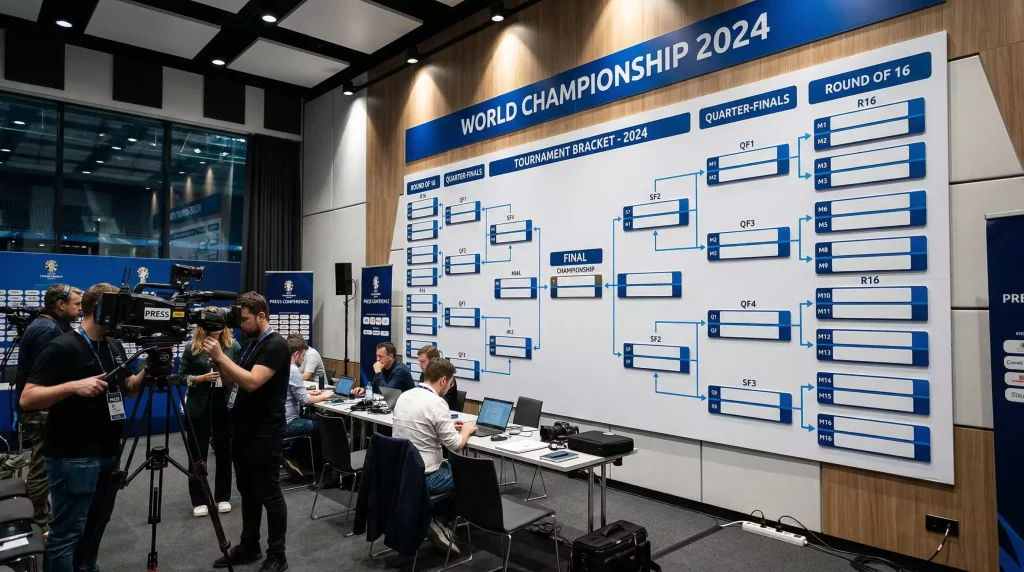
The Final Four: Our Complete Bracket
Spain, England, France, and Argentina comprise my predicted semi-finalists. Each arrives through distinct paths, and each possesses genuine claims to tournament triumph that my bracket picks simply assess as slightly inferior to Spain’s convergence of factors.
France reaches semi-finals through Group I dominance and knockout bracket fortune. Mbappé at peak age, leading a squad rebuilt around his acceleration and finishing, creates matchup problems that few defenses can solve consistently. Their quarter-final projects against Germany or Portugal — significant opposition but teams France has beaten repeatedly in recent tournaments. The semi-final would likely pit them against Argentina in a 2022 final rematch. France loses that rematch in my projection, Messi’s final tournament carrying emotional momentum that France’s pragmatic approach cannot overcome.
Argentina’s path runs through Group J’s relative ease and a knockout bracket avoiding Spain’s side entirely. Messi at 38 cannot dominate physically, but his tournament intelligence — knowing when to conserve energy, when to accelerate, when to trust teammates — compensates for diminished athleticism. The supporting cast from 2022 remains intact and experienced. Argentina reaches semi-finals, loses to England on penalties in my projection, and Messi’s international career ends with a final four finish that nonetheless feels disappointing given their 2022 triumph.
The bracket’s other half produces Spain-England. Germany and Brazil — teams casual observers might expect in a Final Four — fail to reach that stage in my predictions. Germany’s back-to-back group stage eliminations reflect systemic issues that one Nagelsmann year cannot resolve. Brazil’s attacking talent cannot compensate for organizational vulnerability against structured knockout opponents. Both exit in quarter-finals or earlier.
My predicted final score: Spain 2, England 1. Yamal and Rodri score for Spain; Bellingham pulls one back late. England apply pressure in closing minutes, Spain hold. The trophy travels to Madrid rather than London. English pain continues into another cycle.
Dark Horse Special: One Team to Watch Closely
Every World Cup produces a team that exceeds pre-tournament expectations dramatically. Croatia in 2018 (reached final). Morocco in 2022 (reached semi-finals). These runs share common characteristics: underrated tactical organization, a core of players hitting peak form simultaneously, and draw fortune placing them against beatable opposition until very late rounds.
My 2026 dark horse selection is Japan. The reasoning extends beyond their 2022 group stage victories over Germany and Spain, though those results matter as proof of concept. Japan’s squad composition has evolved since that tournament, with additional players establishing themselves at elite European clubs. Their tactical flexibility — capable of both possession-based and counterattacking approaches depending on opponent — suits tournament football’s match-to-match variability.
Group F places Japan against Netherlands, Sweden, and Tunisia. Netherlands favors as group winner, but Japan could absolutely beat them — their 2022 Spain victory demonstrated capability against Dutch-style possession play. Finishing second means a round of 32 match against Group E’s likely second place (Ecuador or Ivory Coast), neither representing insurmountable opposition. Round of 16 projects toward Group H’s winner — Spain most likely, admittedly a difficult assignment.
Japan’s ceiling depends on whether their best eleven can maintain fitness and form across multiple knockout matches. Their depth concerns remain genuine — the drop-off from starters to backups exceeds most European nations. But assuming injury fortune, Japan reaching quarter-finals seems genuinely likely. Semi-finals would require beating Spain or equivalent, probably too much to ask. Yet “probably” is not “certainly,” and at odds around +5000 for that finish, the value case is compelling.
What makes Japan particularly interesting for bettors: the market still prices them as an Asian curiosity rather than a genuine threat. Their 2022 performances receive “fluke” treatment that Morocco’s run escaped, perhaps because Morocco followed their group stage with knockout wins while Japan lost to Croatia on penalties. That perception gap creates opportunity. Japan has proven they can beat elite European teams. The market has not fully priced that proof.
Upset Alert: Where We Disagree with the Market
My predictions diverge from consensus in several areas, and transparency about those disagreements allows you to identify where my analysis might prove either prescient or wrong.
Brazil to exit before quarter-finals represents my most contrarian position. The market treats Brazil’s +750 odds as appropriate for a genuine contender. I view them as overpriced, their organizational weaknesses masked by individual attacking brilliance that cannot carry them through seven consecutive knockout matches. Their 2022 penalty exit to Croatia — after dominating that match territorially — revealed fragility under pressure that subsequent squad changes have not obviously addressed. Group C’s Morocco assignment provides an early test that could produce upset before knockouts even begin.
Germany surviving group stage but failing in round of 16 or quarter-finals aligns with my view that their “revival” narrative overstates actual improvement. Nagelsmann’s tactical innovations impressed against weaker qualifying opponents; whether Musiala and Wirtz can perform under genuine knockout pressure remains unproven. The market’s +900 price implies approximately 10% championship probability, which I assess as roughly double their actual chances.
Belgium as a round of 16 exit rather than quarter-final fixture reflects my belief that their golden generation has passed viable contender status. De Bruyne’s fitness, Lukaku’s form inconsistency, and the absence of defensive reinvention create vulnerabilities that Group G’s weakness temporarily obscures. Their knockout draw projects toward a meeting with Portugal or Colombia — opponents who have not consistently beaten Belgium but possess the quality to do so now.
On the bullish side, I rate Croatia’s path to quarter-finals as more likely than their +2500 tournament odds imply. Their round of 16 or quarter-final exit probability exceeds market pricing — but more importantly, their probability of reaching semi-finals exceeds what +2500 brackets. Croatia in a Final Four would not surprise me, even as tournament winner would.
Group Stage Outcomes: All 12 Groups Predicted
Group stage predictions require balance between expected outcomes and upset potential. Every group features at least one plausible surprise; predicting “favorites advance” in all twelve groups misses the tournament’s inherent variance. My picks incorporate one or two “against-consensus” calls reflecting where I see market inefficiency.
Group A: Mexico first, South Korea second. Mexico’s home advantage in the opening match and familiarity with conditions across Mexican venues gives them edge over South Korea’s pure talent. South Africa and Czechia contest third place without serious qualification hopes.
Group B: Switzerland first, Canada second. This is the group Canadian bettors care most about. Switzerland’s tournament pedigree — Euro 2024 quarter-final, consistent round of 16 appearances — makes them deserved favorites. Canada’s home advantage and dramatically improved squad composition since 2022 positions them for comfortable second-place qualification ahead of Qatar and Bosnia.
Group C: Brazil first, Morocco second. Brazil should handle this group despite Morocco’s semi-final credentials. Scotland returning after 26 years provides romantic narrative but limited knockout threat. Haiti celebrates qualifying rather than expecting advancement.
Group D: USA first, Türkiye second. This represents an against-consensus pick — many projections favor USA as comfortable winners with Australia or Paraguay taking second. I believe Türkiye’s talent (Arda Güler, Hakan Çalhanoğlu) and European competitive exposure gives them edge over Australia’s squad depth or Paraguay’s South American grit.
Group E: Germany first, Ecuador second. Germany should top this group, but their consecutive group stage eliminations create genuine concern. Ecuador’s young squad and Moisés Caicedo’s world-class midfield presence makes them viable for second over Ivory Coast despite the latter’s AFCON credentials.
Group F: Netherlands first, Japan second. The group’s quality makes this prediction less certain than most. Sweden could absolutely beat Japan; Tunisia might surprise. But Netherlands’ overall superiority and Japan’s proven giant-killing capability positions them as my top two.
Group G: Belgium first, Egypt second. Against consensus again — most projections give Belgium comfortable first with Iran second. Egypt’s offensive potential (if Mohamed Salah remains fit) and Iran’s defensive limitations creates opportunity. Belgium’s vulnerabilities might allow second place, but Group G’s weakness should still yield their qualification.
Group H: Spain first, Uruguay second. Spain dominates this group; the question is Uruguay versus Saudi Arabia for second. Uruguay’s talent (Darwin Núñez, Federico Valverde) and Bielsa’s tactical discipline makes them clear favorites for runner-up despite Saudi Arabia’s 2022 Argentina upset.
Group I: France first, Senegal second. France cruises; Senegal edges Norway despite Erling Haaland’s first World Cup appearance. Haaland’s relative inexperience at international level — he has never played a World Cup match — creates downside risk that Senegal’s tournament-tested squad avoids.
Group J: Argentina first, Austria second. Argentina as defending champions should handle this group comfortably. Austria’s quality (David Alaba, if fit) gives them edge over Algeria’s atmospheric support and Jordan’s historic debut.
Group K: Portugal first, Colombia second. Competitive group with genuine second-place uncertainty. Colombia’s James Rodríguez renaissance and Luis Díaz’s Liverpool form creates attacking threat that Uzbekistan’s World Cup inexperience cannot match.
Group L: England first, Croatia second. The heavyweight draw lands here. England versus Croatia provides a proper rivalry match determining group winner. Ghana and Panama fight for scraps.
Canada’s Journey: How Far Can Les Rouges Go?
My prediction for Canada: group stage advancement to round of 32, exit in that round against a superior opponent, but with honor and competitive performance that establishes their World Cup credentials for future cycles.
This feels unsatisfying for those hoping I would predict a miracle run. But World Cup 2026 predictions require honesty about current squad limitations even while acknowledging dramatic improvement since 2022’s winless group stage. Canada enters as a host nation with genuine home advantage. They do not enter as a genuine trophy contender.
The group stage path appears manageable. Switzerland deserves favorite status, their Euro 2024 quarter-final and consistent knockout-round presence establishing tournament credentials Canada lacks. But second place behind Switzerland means facing Group A’s winner — likely Mexico — in the round of 32. That represents a winnable match, though Mexico’s CONCACAF experience and World Cup history creates meaningful disadvantage for Canada.
Alphonso Davies at left back and occasionally left wing provides world-class quality at one position. Jonathan David’s goal-scoring consistency at Juventus proves elite finishing ability. The remaining squad features solid professionals rather than stars — players who would start for mid-table European clubs but not champions. That composition can absolutely produce group stage advancement. It cannot, in my assessment, produce deep knockout runs against nations featuring multiple world-class players across the pitch.
Where Canada might exceed this prediction: if Davies delivers a tournament-defining individual performance, dragging teammates to victories through personal brilliance. If John Herdman (or whoever manages by then) implements a tactical system that neutralizes superior opposition through collective discipline. If the home crowd advantage proves even more powerful than expected, intimidating opponents and lifting Canadian players beyond their typical level. These factors could push Canada to quarter-finals. They would require everything breaking right simultaneously.
The realistic ceiling is round of 16. The probable outcome is round of 32 exit. The floor — group stage elimination finishing third behind Switzerland and a resurgent Bosnia — exists but seems unlikely given Canada’s genuine improvement and Group B’s favorable composition. My specific prediction: Canada finishes second in Group B with 6 points (victories over Qatar and Bosnia, loss to Switzerland), then loses 2-1 to Mexico in round of 32 after competing admirably for seventy minutes before fatigue and squad depth disparities tell. For complete squad analysis and betting angles, see our Canada World Cup 2026 guide.

Top Scorer Prediction: Our Golden Boot Pick
Kylian Mbappé wins the Golden Boot with seven goals, edging Harry Kane and Vinícius Júnior by a single strike. This prediction accounts for penalty duties, team advancement, and historical scoring patterns at major tournaments.
Mbappé’s case rests on multiple factors converging. France should reach at least semi-finals, providing six or seven matches for accumulation. He takes penalties for France, essentially guaranteed opportunities that open-play-only scorers cannot access. His physical prime at age 27 combines peak speed with refined finishing — the explosive youth of 2018 now complemented by mature positioning. His eight goals at Qatar 2022 demonstrated capability; the tournament structure favors repetition.
Kane’s challenge comes from similar structural advantages: England’s expected deep run, penalty duties, and consistent elite finishing. His club-level goal rates at Bayern Munich prove sustained scoring ability. The gap between Mbappé and Kane sits within variance margins — either could win depending on two or three match outcomes.
Vinícius Júnior represents the wild card. Brazil’s attacking system channels through him, his dribbling creating chances for himself and teammates. If Brazil reaches later rounds — uncertain given their recent tournament struggles — Vinícius could explode across multiple matches. His Golden Boot case depends on Brazil’s advancement more than personal finishing consistency, which has proven streakier than Mbappé’s clinical reliability.
Dark horse candidates exist in the +2500 to +5000 range. Julián Álvarez benefits from Argentina’s system and Messi’s service. Lamine Yamal could emerge as a genuine scorer rather than purely a creator. Darwin Núñez might catch fire if Uruguay advances beyond expectations. But the favorite-level picks — Mbappé, Kane, Vinícius — capture most of the realistic probability distribution.
Young Star Spotlight: Breakout Candidate
Lamine Yamal enters World Cup 2026 as the most exciting young talent in global football, but his Euro 2024 brilliance already established his reputation. The genuine breakout candidates — players whose tournament performances will introduce them to casual audiences — operate at lower recognition thresholds.
My breakout pick is Arda Güler of Türkiye. At 21 years old, the Real Madrid attacking midfielder possesses technical ability that video clips cannot fully capture. His left foot creates goals from positions other players would not attempt. Türkiye’s group stage matches provide platform for individual brilliance that more structured teams might suppress. Even if Türkiye exits early, Güler’s performances could announce his arrival to audiences who know only his Madrid substitute appearances.
Alternative candidates include Endrick (Brazil), whose teenage talent might receive significant minutes if Brazil’s elder attackers tire or underperform. Kobbie Mainoo (England) could see tournament action that his Manchester United role already suggests is deserved. Enzo Le Fée (France) offers midfield depth that might prove necessary across seven potential matches.
The breakout definition matters. These predictions identify players who enter the tournament with modest global recognition and exit with household-name status — not necessarily the tournament’s best performer, but the one whose rise captures imagination. Yamal already achieved that arc. The next generation’s version awaits its World Cup moment.
Disappointment Watch: Favorites That Could Fall
Every World Cup humiliates at least one pre-tournament favorite. Germany’s 2018 and 2022 group stage eliminations. Spain’s 2014 disaster. Italy’s 2022 absence. Identifying which favorite sits most vulnerable to embarrassment requires examining where public perception most diverges from underlying fragility.
Brazil tops my disappointment watch. Their +750 odds imply approximately 12% championship probability — fifth-highest in the tournament. Yet their recent World Cup performances inspire minimal confidence: 2022 quarter-final penalty exit, 2018 quarter-final exit to Belgium, 2014 home humiliation. The talent collection exists; the tournament mentality does not. Brazil plays brilliant club football and fragments under World Cup pressure. Until they prove otherwise, treating them as genuine contenders feels like reputation betting rather than current-form analysis.
Belgium’s golden generation receives its farewell tournament at reduced capacity. De Bruyne’s injuries have accumulated. Lukaku’s finishing has deteriorated. The defensive core aged without replacement. Market pricing at +1600 still treats them as dark horse contenders; I view them as likely round of 16 or quarter-final exit against any properly organized opponent. Their Group G ease might temporarily obscure these vulnerabilities until knockout rounds expose them.
Argentina faces the defending champion curse that has claimed every titleholder since Brazil’s 1962 repeat. The psychological burden of defending rather than chasing changes team dynamics in subtle but meaningful ways. Messi’s age creates physical limitations that 2022’s tournament-high adrenaline temporarily masked. Argentina could absolutely reach semi-finals — they remain among the tournament’s ten best squads — but expectations of another final feel unrealistic given historical patterns and squad evolution.
The disappointment designation does not mean these teams will definitely fail — it means their failure probability exceeds what their odds imply. Brazil crashing out in group stage would shock casual observers; it would not surprise anyone who has watched their recent tournament performances carefully.
The Tournament We Expect: A Summary
My World Cup 2026 predictions compress into a single narrative: Spain completes their generational ascent by winning the tournament, defeating England in a final that continues the Three Lions’ agonizing near-miss tradition. France and Argentina reach semi-finals through opposite brackets. The defending champion curse claims Argentina; France falls to Spain in the semi-final rematch of Euro 2024.
Canada advances from Group B in second place, provides home fans with competitive performances and genuine pride, then exits in round of 32 against Mexico. This outcome satisfies no one who imagined a miracle run but establishes Les Rouges as a legitimate World Cup nation rather than the tourist squad that scored zero goals in 2022.
Brazil disappoints. Belgium disappoints. Germany stabilizes without truly threatening. The tournament’s romance comes from Japan’s semi-final push (my dark horse) and from the four debuting nations — Cape Verde, Curaçao, Jordan, Uzbekistan — whose presence celebrates global football’s expansion even if their knockout hopes remain minimal.
These World Cup 2026 predictions will prove partially wrong. The tournament’s beauty emerges from unpredictability that no analysis can fully capture. Morocco’s 2022 semi-final defied every pre-tournament projection; similar surprises await in 2026. My goal is identifying likely outcomes while acknowledging that unlikely outcomes happen frequently enough to demand humility. For current pricing on all these picks, see our World Cup 2026 odds breakdown.
The 104 matches between June 11 and July 19 will provide drama, heartbreak, and moments that transcend any betting context. Use these predictions as framework — something to measure actual results against, something to reconsider as the tournament unfolds, something to remember either as validation or humbling evidence that World Cups resist prediction. Either way, the tournament begins soon. Everything changes when the whistle blows.
