
World Cup 2026 Group K: Portugal and Colombia Clash
 Available in US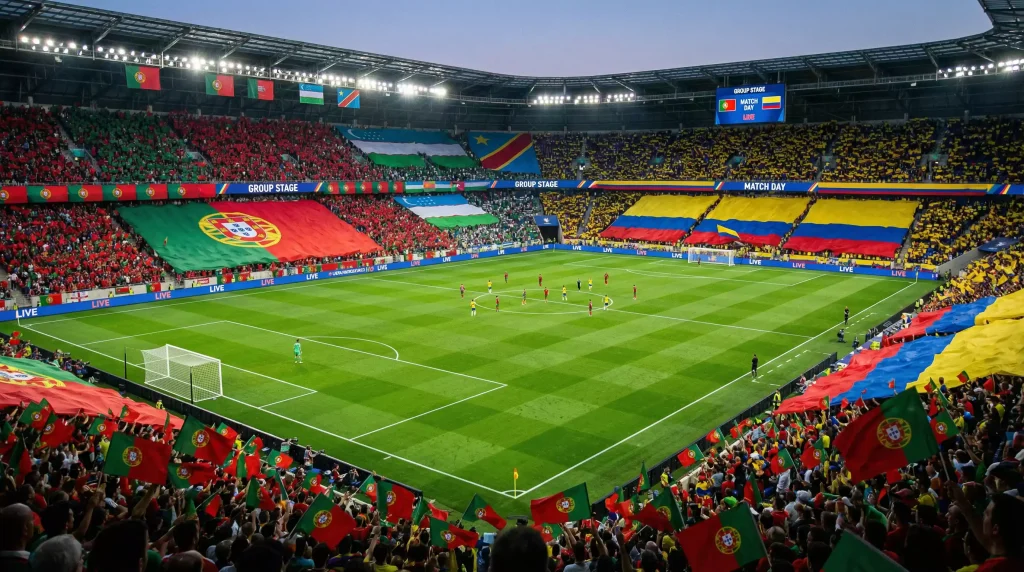
Table of Contents
Two nations who’ve never won the World Cup but possess the talent to change that. Two debutants experiencing football’s biggest stage for the first time. Group K presents a fascinating hierarchy where Portugal and Colombia enter as clear favorites, separated by margins thin enough that their direct encounter could determine first place, while Uzbekistan and DR Congo hope their historic qualifications lead to competitive performances rather than merely participation.
The Portugal-Colombia matchup ranks among the tournament’s most anticipated group-stage fixtures. Both nations feature attacking riches that should produce goals, tactical sophistication that creates chess-match intrigue, and historical near-misses that fuel contemporary ambition. For betting markets, this group offers genuine drama at the top alongside underdog stories that could produce memorable moments from Central Asia and Central Africa. My analysis of Group K requires addressing both the favorites’ duel and the debutants’ dreams with equal seriousness.
Star Power Meets South American Flair
Portugal’s post-Ronaldo transition has produced something unexpected — a team that might be better balanced without constant accommodation of its greatest player. The debate continues about whether Cristiano Ronaldo remains capable of contributing at the highest level, but Portugal’s younger generation has demonstrated they don’t require his presence to compete with anyone. Rafael Leão, João Félix, Bernardo Silva, Bruno Fernandes — these players create attacking variety that doesn’t depend on one central figure demanding the ball.
Colombia arrives with renewed confidence after years of inconsistent performances. The James Rodríguez renaissance has revitalized their creative core, while younger talents around him provide energy and pressing intensity that previous Colombian generations lacked. Luis Díaz’s Liverpool form translates to international football with devastating effect, and the midfield blend of creativity and industry supports both defensive structure and attacking transitions.
The direct encounter between these nations represents Group K’s defining moment. Winner likely tops the group; loser must handle business against Uzbekistan and DR Congo while hoping goal difference doesn’t create complications. Both teams possess the quality to defeat the debutants convincingly, making their head-to-head result the primary determinant of group standings.
Betting markets price Portugal slight favorites at around 1.75 to win the group, with Colombia at 2.40. That margin reflects European bias more than objective quality assessment — Colombia’s attacking talent and recent form arguably match Portugal’s, and home-continent advantage (the tournament’s North American venues suit South American teams more than European ones) could prove decisive. I see genuine value in Colombia’s group-winning odds against a Portuguese side still determining its optimal configuration.
Group K: The Competitive Quartet
Unlike groups where one heavy favorite dominates while three others fight for scraps, Group K features genuine competition at the top with two established powers and intriguing stories beneath them. The structural balance creates multiple compelling narratives — the Portugal versus Colombia championship, the Uzbekistan versus DR Congo battle to avoid last place, and the potential upsets where debutants steal points from favorites who underestimate their organization.
Uzbekistan makes their first World Cup appearance after decades of Asian football development that’s finally produced a qualifying squad. Their pathway through Asian qualifiers demonstrated competitive ability against established powers, and the tournament provides validation for investment in domestic leagues and youth academies. Expectations remain modest — any points would represent success — but their presence enriches a group that benefits from global representation.
DR Congo returns to the World Cup after a 52-year absence, their previous appearance coming in 1974 as Zaire when different political circumstances shaped national identity. The Léopards have produced excellent players for European clubs while struggling to translate individual talent into collective international success. This tournament offers redemption and exposure, showcasing Congolese football to global audiences who know their players but not their national team’s potential.
Second-place markets present interesting opportunities. Portugal and Colombia should both advance, making the real betting question which finishes where rather than whether either fails to qualify. If Portugal loses to Colombia, they must handle Uzbekistan and DR Congo without slipping — a more demanding task than it appears when considering the psychological impact of opening-match defeats and the desperation of opponents fighting for their only achievable victories.
Portugal: The Post-Ronaldo Era Begins?
Cristiano Ronaldo’s presence or absence dominates every conversation about Portuguese football, sometimes unfairly overshadowing the extraordinary talent that surrounds him. The debate enters its decisive phase at World Cup 2026 — if Ronaldo appears, he’ll be 41, attempting to compete at levels where physicality and pace determine outcomes. If Portugal moves forward without him, they remove a psychological crutch while potentially liberating attacking players who’ve operated in his shadow.
Roberto Martínez’s tenure has coincided with tactical evolution that positions Portugal for sustainable success. The former Belgium coach implemented systems that distribute attacking responsibility across multiple players rather than funneling everything through one central figure. Leão’s dribbling, Félix’s movement, Silva’s creativity, Fernandes’s passing — these qualities combine into attacking variety that creates problems from different angles rather than predictable patterns.
Defensively, Portugal has strengthened through Rúben Dias’s emergence as a genuine elite center-back and Diogo Costa’s goalkeeping development. The full-back positions offer attacking thrust from João Cancelo and Nuno Mendes, creating width that stretches defenses and opens central areas for creative midfielders. Portugal’s defensive vulnerabilities persist in transition, where pace can expose positioning errors, but their overall structure has improved from previous tournaments where individual brilliance compensated for organizational gaps.
The Colombia match represents Portugal’s primary test. Victory there essentially clinches first place, allowing rotation against Uzbekistan and DR Congo that preserves energy for knockout rounds. Defeat creates pressure situations where slip-ups against debutants could complicate advancement. Portugal’s quality should handle either scenario, but the psychological difference between controlling their fate and depending on other results matters when stakes escalate.
Portugal’s complete tournament profile suggests they’re genuine contenders for deep runs beyond the group stage. The squad depth exceeds previous generations, the tactical sophistication provides structural advantages, and the post-Ronaldo transition — whenever it fully occurs — might actually strengthen rather than weaken their championship prospects. Group K represents an opportunity to establish momentum and confidence heading into elimination rounds where Portugal historically has underperformed relative to squad quality.
Colombia: James and the Next Generation
James Rodríguez scored arguably the greatest World Cup goal in 2014, a volley against Uruguay that announced his arrival on the global stage. That tournament saw Colombia reach the quarter-finals with football that combined South American flair with tactical discipline, establishing expectations that subsequent campaigns failed to meet. The 2018 World Cup ended in a penalty shootout loss to England. The 2022 tournament proceeded without Colombia entirely after a disappointing qualifying campaign. Now James returns for what might be his final World Cup, surrounded by talent that could finally deliver results matching the 2014 promise.
Luis Díaz transforms Colombia’s attack from promising to dangerous. His Liverpool performances demonstrate finishing, dribbling, and creative ability that trouble the best Premier League defenses, and those qualities translate to international football where he’s become the team’s most important player. Around Díaz, other attacking options have emerged — Jhon Arias, Luis Sinisterra, Rafael Santos Borré — creating depth that previous Colombian squads lacked.
Midfield control has improved dramatically. Ríchard Ríos provides defensive stability, James orchestrates from deeper positions that suit his reduced mobility, and others contribute industry that balances creative ambition with territorial responsibility. Colombia under current management presses higher and recovers possession more efficiently than previous iterations, creating attacking opportunities through organization rather than just individual quality.
The defensive concerns haven’t fully resolved. Center-back partnerships lack the consistency Colombia needs against elite opposition, and goalkeeping questions persist despite improvement from the nadir that characterized qualifying struggles. Against Portugal, defensive vulnerabilities will be tested by attacking quality that punishes errors ruthlessly. Colombia must hope their own offensive production exceeds what they concede — an entertaining but anxiety-inducing approach to knockout football.
Colombia’s group-stage goal is clear: beat Portugal and cruise through remaining matches. The psychological impact of defeating European opponents would establish belief that South American quality can compete with anyone. If they lose to Portugal, the second-place finish still represents success, but the momentum and confidence differ significantly. Everything flows from that single match — Colombia’s entire tournament could be defined by 90 minutes against Portuguese opposition.
Uzbekistan: Central Asian Debutants
Football has existed in Uzbekistan since Soviet times, when the region produced players who competed in top-tier leagues and represented the USSR at various levels. Independence in 1991 launched a separate footballing identity that’s taken three decades to mature into World Cup qualification. The White Wolves arrive in North America as historic debutants, representing 35 million people experiencing football’s ultimate stage for the first time through their national team.
The qualifying campaign demonstrated Uzbekistan can compete against established Asian powers. They defeated Japan, challenged Saudi Arabia, and accumulated points against opponents with significantly more resources and tournament experience. The technical quality exceeds typical underdog designations — Uzbek players compete in European leagues at various levels, bringing tactical awareness and physical preparation that suits World Cup demands.
Eldor Shomurodov leads the attack with Serie A experience and goal-scoring ability that’s proven against respectable European defenses. Around him, the supporting cast combines domestically-developed talents with diaspora players recruited through international pathways. The squad depth doesn’t match Portugal or Colombia, but the starting eleven can compete for 60-70 minutes against anyone before fatigue and limited substitution quality create disadvantages.
Tactical discipline defines Uzbekistan’s approach. They’ll defend compactly, transition efficiently, and hope set-pieces create opportunities that open play denies. Against Portugal and Colombia, accepting defensive postures while hoping for counter-attacks represents realistic strategy. Against DR Congo, more ambitious approaches might emerge as both debutants seek the points that would validate their qualification and avoid finishing last.
Betting markets price Uzbekistan around 12.00 or longer to advance from Group K. Those odds appropriately reflect the challenge against Portugal and Colombia, though the DR Congo match presents genuine upset potential if Uzbekistan’s organization exceeds African opponents’ individual brilliance. A single victory would constitute remarkable success; a point from any match would provide memories their nation will celebrate regardless of overall group-stage outcome.
DR Congo: Les Léopards Arrive
The Democratic Republic of Congo has produced outstanding footballers for European clubs across multiple generations. From Shabani Nonda through Yannick Bolasie to current stars scattered across top leagues, Congolese talent has enriched football without translating into national team success at the World Cup level. The 1974 appearance as Zaire ended badly — a 9-0 loss to Yugoslavia and other defeats that reflected both quality gaps and political interference in team affairs. Fifty-two years later, Les Léopards return seeking redemption.
The current squad features Premier League and Ligue 1 talents who’ve proven capable against elite competition. Chancel Mbemba anchors defense from Marseille, Yoane Wissa scores goals for Brentford, and various others contribute from positions across European football. The individual quality exists; the question is whether collective organization can harness it effectively against opponents who approach matches with clear tactical identities.
African Cup of Nations performances have disappointed relative to expectations, raising questions about whether DR Congo’s talented generation can deliver when tournament stakes apply. The World Cup provides an elevated platform for proving doubters wrong, but also heightened pressure that’s historically affected performances negatively. Managing expectations while maintaining competitive belief represents the coaching staff’s primary challenge.
The Uzbekistan match becomes crucial for DR Congo’s group-stage narrative. Both debutants enter with limited realistic advancement hopes, making their direct encounter the contest where victory is genuinely achievable. DR Congo’s individual talent should create advantages against Uzbek defenders, though the Asian team’s organization could neutralize African flair through disciplined positioning. Whoever wins that match avoids last place and claims a moral victory regardless of results against Portugal and Colombia.
Betting on DR Congo requires accepting significant risk for potentially significant reward. Their odds around 15.00 to advance reflect near-impossible tasks against both favorites, yet their individual quality creates upset potential that pure statistical models might undervalue. A Wissa hat-trick against underperforming European defenders isn’t impossible — improbable, certainly, but not impossible. Extreme long-shot bettors might find value; risk-averse approaches should direct capital elsewhere.
Schedule and Venues
Group K fixtures unfold across American venues with timing that accommodates global audiences while favoring North American viewership. The Portugal versus Colombia opener draws the most significant attention — two contenders establishing early advantages while debutants observe the competitive standard they must match. The scheduling ensures both favorites face their toughest test first, creating potential for momentum shifts that reshape group dynamics.
Portugal versus Colombia represents Group K’s championship match regardless of when it occurs. First place likely follows the winner, while the loser must handle remaining fixtures professionally to secure second. The tactical matchup favors entertaining football — both teams prefer attacking over defensive approaches, creating open matches where goals seem likely from both sides. For neutral observers, this fixture offers everything World Cup group stages should provide.
Uzbekistan versus DR Congo simultaneously determines the group’s floor. Neither team enters with realistic advancement hopes, making their encounter about pride, validation, and avoiding last-place finishes. The stylistic contrast — Uzbek organization versus Congolese flair — could produce either tactical chess or open attacking football depending on coaching approaches. Whichever team prevails claims bragging rights that matter regardless of subsequent results.
The second round brings Portugal versus DR Congo and Colombia versus Uzbekistan. These matches should confirm the favorites’ advancement while giving debutants opportunities to compete against elite opposition. Portugal might rotate slightly if they defeated Colombia in the opener, while Colombia would approach with maximum intensity if recovering from an opening loss. The debutants’ goals shift toward stealing points — a draw against either favorite would constitute remarkable achievement.
Final matchday pairs Portugal versus Uzbekistan and Colombia versus DR Congo. By this point, first place should be decided between the favorites, leaving qualification mathematically secure for both. The matches provide opportunities for debutants to end their World Cup experiences positively, competing against potentially rotated squads from favorites preserving energy for knockout rounds. Goal difference could matter if earlier results created tight standings, though the most likely scenario sees Portugal and Colombia advancing comfortably.
Portugal vs Colombia: Who Tops Group K?
The direct encounter determines everything. Portugal’s slight betting favorite status reflects European perceptions rather than decisive quality advantages, and Colombia’s South American flair, continental proximity to tournament venues, and attacking firepower create genuine upset potential. I see this match as closer to a coin flip than odds suggest — both teams can beat each other, and whoever performs better on the day claims first place.
Portugal should collect seven to nine points regardless of the Colombia result, handling Uzbekistan and DR Congo with professional efficiency. Their squad depth allows rotation without quality loss, and their tactical sophistication creates advantages against opponents who can’t match their individual quality or organizational discipline. Advancing from Group K represents expectation, not achievement, for Portuguese football — the tournament begins in earnest during knockout rounds.
Colombia matches Portugal’s likely point haul, with the direct encounter determining first versus second place. Their attacking talent rivals Portugal’s, their motivation matches European determination, and their recent form suggests competitive performances against anyone. Second place still advances to knockout rounds, making Colombia’s group-stage outcome successful regardless of whether they top the group or finish behind Portugal.
Uzbekistan finishes third with one to three points, potentially stealing something from DR Congo while competing honorably against Portugal and Colombia. Their World Cup debut provides memories and validation regardless of results, though any points accumulated exceed expectations and establish Central Asian football’s competitive potential. The experience benefits Uzbek football’s long-term development even if immediate results disappoint.
DR Congo finishes fourth with zero to three points, matching Uzbekistan’s range while potentially losing their direct encounter. The 52-year absence ends with participation rather than progression, which still represents achievement for Congolese football. Individual performances might attract European club attention for players seeking transfers, providing silver linings within group-stage elimination. Les Léopards’ World Cup return sets foundations for future campaigns where expectations can legitimately exceed 2026’s humble positioning.
Betting opportunities favor Colombia’s group-winning odds at 2.40 against Portugal’s 1.75. The margin seems excessive given squad qualities and likely match dynamics. Individual match markets offer additional value — both favorites should score multiple goals against debutants, creating over/under opportunities where totals seem low. The Portugal-Colombia head-to-head could go either way, making draw prices around 3.50 potentially valuable for those expecting tactical caution from two teams who’d both accept a point.
