
World Cup 2026 Group J: Messi’s Final Chapter
 Available in US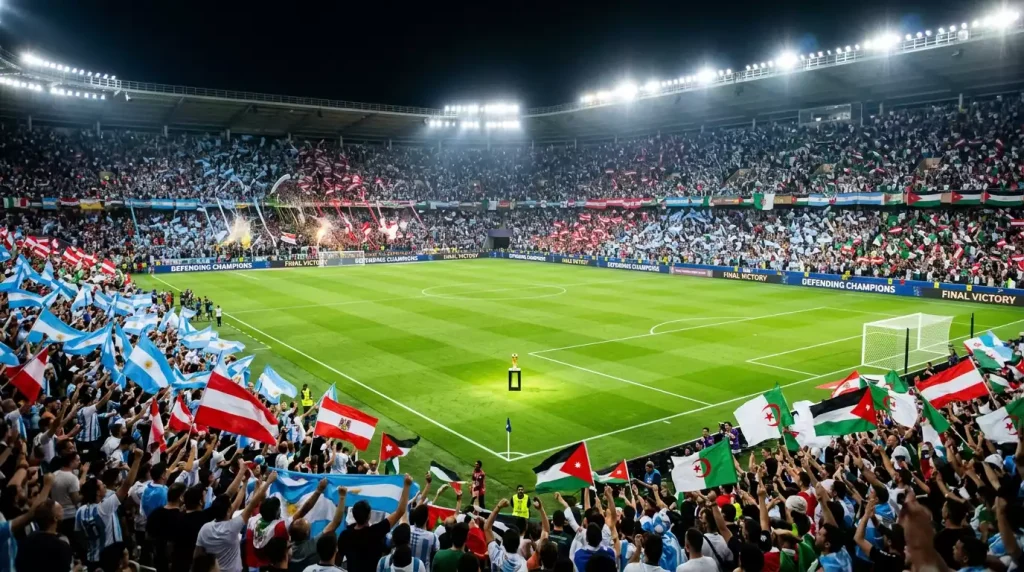
Table of Contents
Three years ago in Qatar, Lionel Messi lifted the World Cup trophy and completed his career’s final missing achievement. The image of him draped in a bisht, golden trophy overhead, teammates surrounding football’s greatest player — that moment closed one chapter while opening another. Can he do it again? At 38, Messi enters the 2026 World Cup as defending champion, still capable of magic that defies biological expectation, still the heartbeat of an Argentine team that’s transformed from tortured nearly-men into confident world beaters. Group J asks whether the fairytale has one more chapter left.
Argentina faces Austria, Algeria, and Jordan — opponents who range from European respectability to tournament debutants discovering what World Cup football demands. The defending champions are massive favorites, priced around 1.20 to top the group, yet the tournament’s expanded format and compressed schedule create vulnerabilities that sharp competitors could exploit. For bettors, Group J offers limited drama at the top but interesting second-place markets where Austria’s European quality meets Algeria’s African passion and Jordan’s historic debut.
The Defending Champions Take the Stage
Defending World Cup titles is historically nearly impossible. Brazil managed it in 1962, Italy in 1938, and no one has succeeded since. The reasons vary — complacency from achieved glory, squad aging, tactical evolution that neutralizes previously dominant approaches. Argentina enters 2026 attempting to join this exclusive club, and their chances depend largely on how long Messi’s brilliance can extend beyond reasonable expectation.
The post-Qatar trajectory reinforced Argentine excellence. The 2024 Copa America victory added another continental title to their collection, demonstrating that 2022 wasn’t a singular peak but a sustainable level of competition. The squad has integrated younger talents while maintaining the core that delivered glory — goalkeeper Emiliano Martínez, defender Cristian Romero, midfielder Rodrigo De Paul, forward Julián Álvarez. Argentina doesn’t depend solely on Messi anymore; they’ve built structures that function with or without his individual interventions.
Yet Messi remains irreplaceable in the ways that matter most. His vision identifies passing lanes others can’t see. His dribbling creates space from nowhere. His mere presence on the pitch forces opponents to account for him, opening opportunities for teammates who might otherwise be marked more tightly. Argentina with Messi operates at a level Argentina without Messi simply cannot reach, and the 2026 World Cup represents his final opportunity to add to a legacy that’s already unmatched in football history.
Group J represents the gentlest possible reintroduction to World Cup pressure. Austria offers European organization without elite individual talent. Algeria brings African Cup passion without the squad depth that Morocco demonstrated in 2022. Jordan makes their World Cup debut as the group’s clear fourth-place finisher. Argentina should navigate these opponents without losing or drawing, accumulating nine points while preserving energy for knockout rounds where genuine challenges await.
Group J: Argentina’s Coronation Path
When FIFA conducted the draw for World Cup 2026, Argentina’s placement in Group J probably disappointed neutrals hoping for dramatic group-stage encounters. No clash with Spain or France, no difficult European opponent capable of pushing the champions to their limits. Instead, Argentina received a group that looks predetermined — win all three matches, advance as comfortable group winners, await knockout opponents who might provide actual competition.
The betting markets agree with this assessment. Argentina’s odds to win Group J hover around 1.20, leaving only 17% probability distributed among alternatives. Austria represents the most realistic challenger at 6.00 for first place, while Algeria and Jordan offer only extreme long shots for group victory. The question isn’t whether Argentina advances — it’s whether anyone can take points off them along the way.
Second place creates the group’s genuine competitive tension. Austria enters as favorites around 2.80, with Algeria at 3.50 and Jordan at 10.00 or longer. The European versus African versus Asian dynamic produces three distinct playing styles, three different approaches to the same goal, and three separate fanbases hoping their nation can accompany Argentina to the knockout rounds.
Austria’s tactical discipline and Bundesliga representation provide the highest floor among Argentina’s opponents. They’re unlikely to embarrass themselves regardless of opponent quality. Algeria’s passionate support and African Cup pedigree create atmosphere and intensity that could trouble opponents who underestimate their commitment. Jordan’s historical significance — their first World Cup — adds emotional weight beyond sporting calculations.
The matches between Austria, Algeria, and Jordan determine knockout qualification. Argentina will handle all three without significant stress, but the results among the other three nations shape who advances alongside them. A tight three-way race remains possible if all three teams beat each other in circular fashion, making goal difference and head-to-head outcomes potentially decisive.
Argentina: Messi’s Farewell Tour
Lionel Scaloni has achieved what previous Argentine coaches couldn’t — building a team that complements Messi rather than depends entirely upon him. The 2022 World Cup victory validated Scaloni’s approach: defensive solidity, midfield control, attacking variety, and Messi positioned to receive the ball in dangerous areas with support rather than isolation. The system works because everyone understands their role, and because the psychological burden of “saving Messi’s legacy” has been lifted by actual trophy success.
The generational transition continues even as Messi remains. Julián Álvarez has established himself as a Manchester City regular, scoring crucial goals and providing the pressing intensity that modern football demands. Enzo Fernández anchors midfield with composure beyond his years, controlling matches in ways that create space for Messi’s creativity. Alejandro Garnacho and other young attackers offer alternatives when opponents attempt to neutralize the captain’s influence.
Emiliano Martínez in goal provides the psychological edge that proved decisive in 2022. His penalty shootout heroics, his ability to unsettle opposing kickers, his presence that commands the area — these qualities can’t be quantified but proved invaluable when elimination stakes applied. Argentina’s goalkeeping security allows defensive risks that might otherwise prove costly, trusting Martínez to clean up mistakes that reach his area.
The defensive unit has evolved since Qatar. Romero remains the anchor, but around him, younger players have earned minutes and proved capable. The fullback positions offer options — Nahuel Molina’s attacking runs, Nicolás Tagliafico’s defensive reliability, alternatives who provide freshness when rotation becomes necessary. Argentina’s depth across the pitch exceeds what they possessed in 2022, suggesting improvement rather than stagnation since their triumph.
Messi’s physical condition determines everything. At 38, he’s moved into a different phase of his career — less dribbling past opponents, more orchestration from deeper positions, fewer sprints but more decisive moments when they arrive. Inter Miami’s MLS environment has preserved his fitness better than European football’s intensity might have, and the World Cup’s significance ensures maximum motivation regardless of regular-season pacing concerns. Argentina’s complete tournament profile depends on Messi’s availability and form, which makes every group-stage minute watched carefully for signs of decline or continued brilliance.
Group J allows Argentina to manage Messi’s minutes without risking qualification. Against Jordan particularly, and possibly against Austria or Algeria depending on early results, Scaloni can rest his captain while trusting the supporting cast to deliver victories. The nine-point haul should come regardless of which lineup takes the field, and preserving Messi for knockout rounds where he’ll be needed represents intelligent tournament management.
Austria: Alaba’s World Cup Ambition
David Alaba has won everything available at club level — multiple Champions League titles with Bayern Munich and Real Madrid, domestic leagues across two countries, individual recognition as one of Europe’s finest defenders. The World Cup remains absent from his trophy collection, and at 34, the 2026 tournament represents his best remaining opportunity to add international success to a decorated career. Austria’s qualification rewarded years of steady development, and Alaba’s leadership provides the foundation for their Group J ambitions.
The Austrian squad has evolved beyond reliance on individual brilliance. Under various coaches, they’ve developed an identity emphasizing pressing intensity, structural discipline, and attacking transitions that threaten opponents who fail to respect their quality. The Bundesliga provides their primary talent pool — Konrad Laimer, Christoph Baumgartner, Marcel Sabitzer, players who’ve succeeded in Germany’s tactical environment and bring that sophistication to international football.
Ralf Rangnick’s influence shaped Austria’s recent development despite his departure. The pressing principles he introduced remain embedded in how Austria approaches matches, creating a consistent identity regardless of opponent quality. Against Argentina, these principles probably won’t produce victories — the quality gap is too substantial. Against Algeria and Jordan, pressing intensity could prove decisive, recovering possession in dangerous areas and capitalizing before opponents reorganize.
Austria’s World Cup history includes memorable moments without sustained success. Third place in 1954 represents their best finish, achieved in an era when fewer nations participated and the tournament’s structure differed significantly. Since then, various appearances have produced group-stage exits without knockout advancement. The 2026 expanded format provides additional pathways forward, and Austria arrives better prepared than most of their previous tournament iterations.
Securing second place in Group J requires Austria to beat Algeria and Jordan while limiting damage against Argentina. A draw against the champions would exceed expectations, but three points from Algeria and Jordan should suffice for advancement if goal difference remains manageable. The challenge is avoiding the upset that could complicate their path — Algeria’s passion and Jordan’s desperation create environments where complacency invites disaster.
Betting markets price Austria around 2.80 for second place, making them favorites among non-Argentina options. I find that pricing fair rather than valuable — Austria should advance, but the margin over Algeria isn’t overwhelming. Their disciplined approach suits tournament football, yet they lack the individual game-changers who might steal matches through moments of brilliance. Consistency rather than inspiration characterizes Austrian football, and Group J rewards consistency sufficiently for knockout qualification.
Algeria: North African Pride
The Desert Foxes carry passionate support wherever they play. Algerian fans transform stadiums into cauldrons of noise and color, creating atmospheres that unsettle opponents and inspire their own players beyond normal capabilities. This support traveled to every venue during their 2019 Africa Cup of Nations triumph, where Algeria went unbeaten en route to continental glory. That success established expectations the current generation must meet or exceed.
The squad has evolved since that AFCON victory, with new faces replacing the heroes who delivered the trophy. Riyad Mahrez remains the most recognizable name, though his influence has waned with age and reduced club football prominence. Around him, younger talents have emerged through French academies and European lower leagues, providing depth without the star power that previous generations possessed. Algeria’s strength lies in collective organization rather than individual brilliance.
African Cup performances since 2019 have disappointed relative to expectations. Early exits and inconsistent qualifying campaigns raised questions about whether the championship generation could sustain their level or whether decline had begun. The World Cup qualification answered some doubts — Algeria navigated African pathways successfully, demonstrating competitive ability against continental rivals. Group J presents a different challenge against European and South American opponents with distinct playing styles.
Against Argentina, Algeria must defend desperately and hope for counter-attacking opportunities. The 2014 World Cup provided precedent — Algeria pushed Germany to extra time in the Round of 16, going down fighting against eventual champions rather than accepting defeat passively. That spirit should travel to 2026, where Algeria can compete for 90 minutes even against superior opponents. Losing to Argentina represents expected outcome; how they lose determines whether confidence remains for matches against Austria and Jordan.
The Austria and Jordan fixtures determine Algeria’s fate. Victory in both would guarantee advancement regardless of the Argentina result. Splitting the matches creates complications where goal difference and head-to-head results matter. Losing to Austria while beating Jordan might not suffice if Austria handles their other matches efficiently. Algeria needs maximum effort in both encounters, treating them as finals that determine their tournament’s success or failure.
Betting odds around 3.50 for Algeria’s second-place finish represent fair value. They’re capable of advancing but face disadvantages against Austria’s European quality and organizational discipline. The emotional investment of Algerian fans could translate to on-pitch performance, but equally might create pressure that undermines composure in tight moments. I see Algeria as genuine competitors for second place rather than favorites, capable of surprise but not expected to deliver it.
Jordan: The Arabian Newcomers
For the first time in their history, Jordan competes at the World Cup. The significance of this achievement extends beyond sporting metrics — Jordan’s qualification represents validation for decades of development, investment, and aspiration in a region where football competes with other traditions for attention and resources. The Nashama (Brave Ones) have proven themselves against Asian competition, earning their place through merit rather than expanded format charity.
The 2023 Asian Cup final appearance shocked observers who hadn’t tracked Jordanian football’s rise. They beat South Korea in the semifinals — South Korea, with their Premier League players and World Cup pedigree — demonstrating that organization and commitment could overcome individual talent disparities. That tournament established Jordan as genuine competitors rather than participants, and the World Cup provides the next challenge on their developmental curve.
The squad features players from various Asian leagues alongside a few European-based professionals. The talent level remains below European and South American standards, but the team’s structure compensates for individual limitations. Compact defensive blocks, efficient transitions, and set-piece expertise have characterized their recent success. Against Group J opponents, these qualities provide competitive foundation even if results ultimately disappoint.
Jordan’s World Cup debut carries pressure and celebration simultaneously. Every match represents a historic occasion regardless of result — their nation playing on football’s biggest stage for the first time. Managing that emotional intensity while maintaining competitive focus challenges players and coaches who’ve never experienced World Cup environments. The atmosphere, the stakes, the global attention — these elements can overwhelm those unprepared for their magnitude.
Realistically, Jordan finishes fourth in Group J. Argentina, Austria, and Algeria all possess more individual quality and tournament experience. A point from any match would constitute success, a goal would provide memories, and competitive performances would validate their presence without requiring upset victories. Jordan’s World Cup journey is about arrival rather than destination — reaching this stage matters more than results once here.
Betting markets price Jordan around 10.00 or longer for second place, appropriate odds for a tournament debutant against established competition. Only extreme optimists should back Jordan to advance, though smaller bets on specific match outcomes — drawing Austria, scoring against Argentina — offer value for those who believe the Asian Cup trajectory continues. Jordan’s presence enriches Group J regardless of results, adding narrative depth and regional representation to the tournament’s story.
Schedule and Venues
Group J fixtures unfold across American venues with timing that suits both North American audiences and global viewership. Argentina’s matches will draw the largest attention regardless of opponent quality, as Messi’s potential final World Cup creates appointment viewing for neutral supporters worldwide. The defending champions’ journey through the group stage represents must-watch television even when competitive tension seems limited.
Argentina versus Algeria opens Group J with immediate intensity. Algerian fans will create electric atmosphere, challenging Argentina to match the emotional energy while maintaining tactical discipline. The result seems predetermined — Argentina victory — but the performance matters for both teams’ momentum and confidence heading into subsequent matches. Algeria needs a spirited showing even in defeat to believe they can advance from other fixtures.
Austria versus Jordan simultaneously offers European discipline against Asian ambition. Austria should prevail through technical superiority and tactical awareness, but Jordan’s defensive organization could frustrate them longer than expected. This match establishes the baseline for second-place competition — if Austria wins comfortably, they’re heavy favorites to advance; if Jordan competes closely, the race remains open through the final matchday.
The second round brings Argentina versus Austria in the group’s most competitive fixture. Austria won’t match Argentina’s quality, but they’ll organize compactly and challenge the champions to break them down systematically. Alaba’s defensive leadership against Messi’s creativity provides individual intrigue within the team matchup. A draw would represent Austrian success, though Argentina should prevail through talent that eventually finds solutions against any defensive structure.
Algeria versus Jordan occurs simultaneously, with elimination stakes for both. Losing this match essentially ends knockout hopes for either team, making it a de facto final for second-place candidacy. The styles contrast — Algeria’s African intensity against Jordan’s Asian discipline — in ways that could produce either flowing football or tactical chess. Winner maintains advancement hopes; loser faces mathematical elimination requiring improbable results elsewhere.
Final matchday features Argentina versus Jordan and Austria versus Algeria. If Argentina has already secured first place with six points — overwhelmingly likely — they might rest key players including Messi against Jordan’s historic opponents. Austria versus Algeria becomes the decisive encounter, with second place potentially on the line. Depending on previous results, this match could be winner-advances or mathematically complex, requiring specific scorelines for advancement.
Argentina’s Group J Dominance?
The defending champions collect nine points with relative comfort, scoring double digits while conceding perhaps once or twice across three matches. Messi features prominently in the opener against Algeria, contributes to the Austria victory, and potentially rests against Jordan depending on stakes and physical condition. Argentina’s path to the Round of 32 contains no genuine obstacles — Group J represents a formality they’ll handle professionally.
Austria finishes second with six points, beating Algeria and Jordan while losing to Argentina by margins that reflect quality disparities rather than embarrassing deficiencies. Alaba’s final World Cup produces knockout-round qualification, validation for Austrian football’s development, and an elimination-round opponent that will likely end their tournament. Advancement itself represents success; expecting deeper runs requires ignoring realistic assessments of their ceiling.
Algeria finishes third with three points, beating Jordan while losing to Argentina and Austria in matches where they compete without prevailing. The Desert Foxes’ World Cup ends in the group stage, disappointing passionate supporters who expected better but reflecting genuine quality gaps against European and South American opponents. The experience provides development opportunities for younger players who’ll lead future campaigns.
Jordan finishes fourth without points but with memories that transcend results. Their World Cup debut celebrates arrival on football’s biggest stage, validates years of developmental investment, and provides inspiration for Jordanian football’s continued growth. Zero points from three matches represents expected outcome against superior opponents; the achievement lies in participation itself rather than competitive success against nations with vastly greater resources and traditions.
Betting opportunities in Group J remain limited. Argentina’s odds are too short for value, Austria’s second-place pricing reflects fair probability rather than opportunity, and extreme long shots on Algeria or Jordan require belief in upsets that evidence doesn’t support. The creative bettor might find value in specific match totals — Argentina’s goal-scoring against Jordan, Austria’s margin against Algeria — but straight qualification markets offer only expected returns at fair prices.
