
World Cup 2026 Group C: Brazil’s Golden Path
 Available in US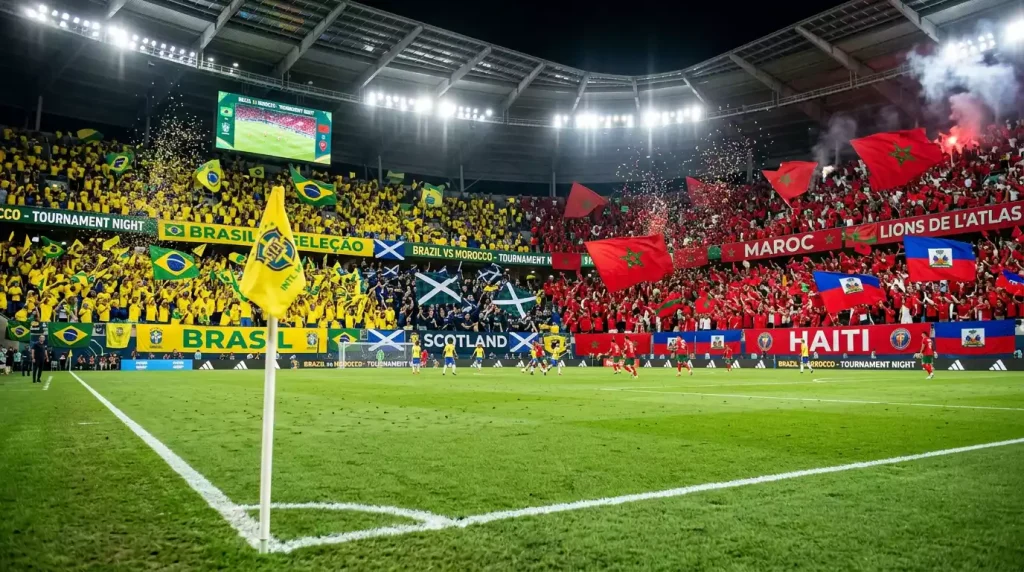
Table of Contents
Brazil hasn’t won a World Cup since 2002 — a drought that has stretched to almost a quarter-century for football’s most decorated nation. Five titles once seemed like the beginning of eternal dominance. Now Brazilians speak of that fifth star on their shirts with nostalgia rather than expectation. World Cup 2026 Group C offers the Seleção a gentle on-ramp toward what they desperately need: redemption under American lights, against opponents who shouldn’t obstruct the path.
But let me complicate that narrative immediately. Morocco reached the 2022 semi-finals — the first African nation to achieve such heights — and returns with ambitions that exceed mere participation. Scotland hasn’t qualified for a World Cup since 1998 and brings 28 years of accumulated hunger. Haiti becomes the smallest nation ever to qualify from CONCACAF, their participation representing an entire region’s underdog story. Group C appears straightforward on paper. Tournament football rarely respects paper.
The Draw: Brazil, Morocco, and Two Underdogs
FIFA rankings tell a specific story about Group C. Brazil sits around 5th globally despite recent struggles. Morocco hovers near 14th, their 2022 run cementing elevated status. Scotland lands in the mid-40s, representing the gap between elite and respectable. Haiti occupies the low 80s, the clearest underdog in the group. The mathematical spread suggests Brazil and Morocco advance comfortably while Scotland and Haiti compete for pride.
Yet those rankings obscure context. Brazil’s qualification campaign through CONMEBOL featured genuine struggles — losses to Argentina, draws with Colombia and Uruguay, performances that raised questions about squad depth and tactical identity. Morocco’s post-2022 trajectory included AFCON disappointment, suggesting that semi-final magic might not replicate automatically. Scotland’s European qualification showed improvement under Steve Clarke, while Haiti’s CONCACAF journey demonstrated that rankings undervalue their actual quality.
The group’s structure creates natural tiers. Tier one: Brazil, clear favourites regardless of recent form. Tier two: Morocco, the team most likely to challenge Brazil for first place or secure comfortable second. Tier three: Scotland and Haiti, competing for third place and potential advancement as one of eight best third-placed teams. This hierarchy might shuffle on individual matchdays, but the overall pattern should hold across the group stage.
What makes Group C compelling isn’t uncertainty about who advances — Brazil and Morocco almost certainly do — but rather the narratives around advancement. Can Brazil reassert dominance? Can Morocco prove 2022 wasn’t a fluke? Can Scotland finally win a World Cup match after decades of failure? Can Haiti write the tournament’s most romantic chapter? Every team carries storylines that transcend points and goal difference.
Brazil: The Seleção Chase Title Number Six
Six head coaches in eight years. Three quarter-final exits since that 2014 home-ground humiliation against Germany. Neymar’s career arc declining from generational talent toward injury-plagued veteran. Brazilian football exists in a state of constant crisis despite possessing more individual quality than almost any nation on earth. The sixth World Cup title has become both obsession and burden — a weight that crushes managers and players who fail to deliver.
The current squad reflects generational transition. Vinícius Júnior has emerged as the genuine star, his Real Madrid exploits establishing him among football’s elite wingers. Rodrygo provides complementary magic on the opposite flank. Raphinha offers versatility and work rate. Behind them, Casemiro’s experience anchors midfield while younger players like Bruno Guimarães and Lucas Paquetá provide energy and creativity. The defense remains Brazil’s weakness — Gabriel Magalhães and Marquinhos are quality center-backs, but the full-back positions lack the attacking brilliance of previous generations.
Tactically, Brazil has oscillated between possession-based systems and more direct approaches depending on managerial philosophy. The current setup emphasizes width and quick combinations in the final third, with Vinícius as the primary threat and others rotating around his movement. Against Group C opposition, expect Brazil to dominate possession above 60% in every match, creating chances through patient build-up rather than counter-attacking transitions.
The psychological dimension matters more than tactics. Brazil players feel immense pressure to perform — social media criticism reaches them immediately, and the Brazilian football media amplifies every mistake into existential crisis. In Group C, this pressure should manifest positively against lesser opponents, where confidence can flow freely. The real test comes in knockout rounds, where Brazil’s mental fragility has repeatedly undermined superior talent.
Winning Group C should be routine. Morocco presents the only genuine challenge, and even then, Brazil’s overall quality should prevail. Seven or nine points, first place, positive goal difference — anything less would trigger another round of panic in Brazilian football circles, even if it matters little for knockout prospects.
Morocco: 2022’s Heroes Return
Walid Regragui took over Morocco two months before the 2022 World Cup and produced the tournament’s most astonishing storyline. Victories over Belgium, Spain, and Portugal en route to the semi-finals transformed Moroccan football’s global perception overnight. A team that had previously been dismissed as decent-but-limited suddenly became feared — their defensive organization, set-piece prowess, and collective mentality confounding European giants.
The question hovering over Morocco in 2026 is simple: was 2022 a perfect storm that won’t repeat, or did it reveal a sustainable footballing identity? Evidence supports both interpretations. The AFCON 2024 campaign ended in disappointment, suggesting that Morocco’s magic doesn’t always travel. But the core group remains intact — Achraf Hakimi, Hakim Ziyech, Sofiane Amrabat — with younger players like Bilal El Khannouss emerging to refresh the squad.
Morocco’s tactical approach emphasizes defensive solidity above all else. Regragui’s 4-3-3 operates with compact spacing, inviting opponents to attack before countering with devastating speed. Hakimi’s overlapping runs from right-back create overloads in wide areas, while Ziyech’s creativity unlocks defenses in the final third. The central midfield works tirelessly, covering enormous distances to maintain structure. When this system functions properly, Morocco becomes genuinely difficult to break down.
Against Brazil, Morocco’s defensive approach makes tactical sense. Absorb pressure, frustrate the Seleção, strike on transitions through Hakimi’s pace and Ziyech’s through balls. This isn’t a path to victory necessarily, but it’s a path to avoiding defeat — valuable in group dynamics where goal difference could matter. Against Scotland and Haiti, Morocco should have sufficient quality to control matches without needing defensive shells.
Second place feels like Morocco’s floor. First place remains achievable if Brazil stumbles. The Atlas Lions enter Group C with credentials and confidence, knowing they belong among tournament contenders rather than hopeful participants.
Scotland: The Tartan Army’s Long Wait Ends
Scotland last played at a World Cup in France 1998, losing all three matches and scoring once. The intervening 28 years produced a catalogue of near-misses, embarrassing defeats, and existential questioning about Scottish football’s direction. Qualification for 2026 ended that drought through a playoff victory that prompted nationwide celebration — finally, the Tartan Army would march again on football’s grandest stage.
The current Scottish squad lacks individual stars but possesses admirable collective spirit. John McGinn brings Premier League quality and leadership from his Aston Villa tenure. Scott McTominay has evolved into a genuine box-to-box threat. Andy Robertson remains one of the world’s best left-backs despite Liverpool’s recent struggles. Billy Gilmour’s technical ability anchors midfield passing. The pieces fit together cohesively, even if none individually threatens world-class status.
Manager Steve Clarke has built Scotland around pragmatic organization rather than stylistic ambition. The 3-5-2 or 3-4-2-1 formations prioritize defensive stability, with wing-backs providing width and midfielders covering enormous territory. Against superior opponents, Scotland sits deep and counter-attacks through McGinn’s driving runs. Against equals or inferiors, they control matches through patient possession without spectacular creativity.
Group C presents Scotland with clear objectives: beat Haiti, compete respectably against Morocco, and avoid humiliation against Brazil. If Scotland can achieve those goals, third place with 3-4 points becomes realistic, potentially enough for advancement as one of eight best third-placed teams. The expanded format helps Scotland’s chances significantly — knockout qualification no longer requires finishing top two.
The emotional dimension for Scotland cannot be overstated. The Tartan Army represents one of football’s most dedicated supporter bases, known for traveling in massive numbers and creating electric atmospheres. Their presence in American stadiums will boost Scottish confidence while entertaining neutral observers. Whether that translates to results depends on Scotland’s ability to manage tournament pressure after nearly three decades without practice.
Haiti: The Caribbean Dream
Haiti’s qualification for World Cup 2026 represents the most remarkable achievement in CONCACAF history. A nation of 11 million people, ravaged by natural disasters and political instability, producing a football team capable of reaching the world’s biggest tournament. The last time Haiti qualified for a World Cup was 1974, when they became the first Caribbean nation to participate. Fifty-two years later, they return under circumstances that deserve celebration regardless of results.
The Haitian squad draws primarily from MLS and European lower leagues, with some domestic-based players contributing. Duckens Nazon, the longtime goal-scoring leader, provides experienced leadership despite his veteran status. Younger players from the diaspora — French-born, American-raised, Canadian-developed — have committed to the national team with genuine passion. The talent level is modest by global standards but sufficient for competitive CONCACAF matches.
Tactically, Haiti operates with defensive discipline and counter-attacking directness. The 4-4-2 or 4-5-1 formations prioritize shape over possession, inviting opponents forward before transitioning quickly through the flanks. Set pieces — both offensive and defensive — receive significant emphasis given Haiti’s physical limitations against larger opponents. In CONCACAF qualifiers, this approach produced enough results to secure advancement.
Against World Cup Group C opposition, Haiti faces steep challenges. Brazil and Morocco possess vastly superior individual quality. Scotland brings better organization and Premier League physicality. Realistic expectations involve competing respectably rather than achieving results — keeping scorelines manageable, creating occasional chances, and representing the Caribbean with dignity.
Yet tournament football occasionally rewards underdogs beyond reasonable expectations. Haiti’s players will compete with nothing to lose and everything to prove. If they catch Brazil or Morocco on an off day, history could happen. More likely, they finish fourth with zero or one points. But qualification itself represents victory, and every match brings global attention to Haitian football’s potential.
Match Schedule and Venues
Group C matches spread across American venues with varied characteristics. Brazil versus Morocco on June 15th at SoFi Stadium in Los Angeles creates the group’s marquee fixture — two semi-final contenders clashing before 70,000 fans in one of football’s most impressive modern venues. The atmosphere should rival anything the tournament produces, with Brazilian and Moroccan supporters traveling in significant numbers.
Scotland faces Haiti on June 13th at Lumen Field in Seattle, a venue known for electric atmospheres when filled with passionate supporters. The Tartan Army should dominate the crowd, creating something approaching home advantage for Steve Clarke’s side. Haiti’s supporters will be present but outnumbered, though their enthusiasm will register.
Matchday two brings Brazil versus Scotland on June 18th at Lincoln Financial Field in Philadelphia, and Morocco versus Haiti on the same date at Gillette Stadium in Foxborough. These fixtures should clarify group standings — Brazil and Morocco winning would essentially secure their advancement, while Scottish or Haitian victories would create chaos.
The finale on June 24th pairs Brazil versus Haiti and Morocco versus Scotland at simultaneous kickoffs across separate venues. By then, most scenarios should be resolved, with group positions largely determined. If somehow results conspire to create meaningful stakes in the finale, the drama could be extraordinary. More likely, established powers cruise through while underdogs process their tournament experience.
For Canadian bettors, Group C times align reasonably well — most matches occur during afternoon or early evening hours Eastern Time, requiring no particular scheduling adjustments. The Brazil-Morocco opener on June 15th represents the group’s most valuable betting opportunity, with genuinely uncertain outcomes despite Brazil’s favouritism.
Group C Predictions and Odds
My projection for Group C: Brazil first with 9 points (three wins), Morocco second with 6 points (two wins, one loss), Scotland third with 3 points (one win, two losses), Haiti fourth with 0 points (three losses). This outcome reflects the clear quality hierarchy while acknowledging that group stage football rarely produces maximum drama when power gaps exist.
The Brazil-Morocco match on June 15th functions as a de facto group final. Whoever wins essentially secures first place, while the loser takes second. A draw splits the difference, leaving goal difference to determine positioning. I favor Brazil in this fixture given their superior individual talent, but Morocco’s defensive system could frustrate the Seleção into errors. A 1-0 or 2-1 Brazil victory seems most likely; a 0-0 draw wouldn’t surprise.
Scotland versus Haiti represents the group’s most asymmetric competitive match. Scotland should win comfortably — their Premier League contingent simply outclasses Haiti’s collection of lower-league players — but Haiti’s desperation could make the match closer than expected. Three-nil to Scotland feels like the appropriate prediction, though 2-0 or 4-0 wouldn’t shock.
Betting value in Group C appears limited given clear favouritism. Brazil to win the group offers minimal returns at short prices. Morocco to beat Scotland and Haiti provides slight value if bundled. The interesting plays involve scorelines: Brazil versus Morocco under 2.5 goals, Scotland to win to nil against Haiti, Haiti to score in any match as a longshot. Goal-related markets often provide better value than outright markets in groups with established hierarchies.
What I’ll watch most closely is Brazil’s mental state. Their talent is undeniable, but tournament pressure has broken Brazilian teams repeatedly since 2002. Group C should be comfortable — the real tests come later. But if Brazil struggles here, if Morocco exposes defensive vulnerabilities or Scotland somehow steals a result, the cascading psychological damage could doom their knockout aspirations before they properly begin. The Seleção need confidence. Group C should provide it. Will it?
