
World Cup 2026 Group A: Mexico Leads the Opening Act
 Available in US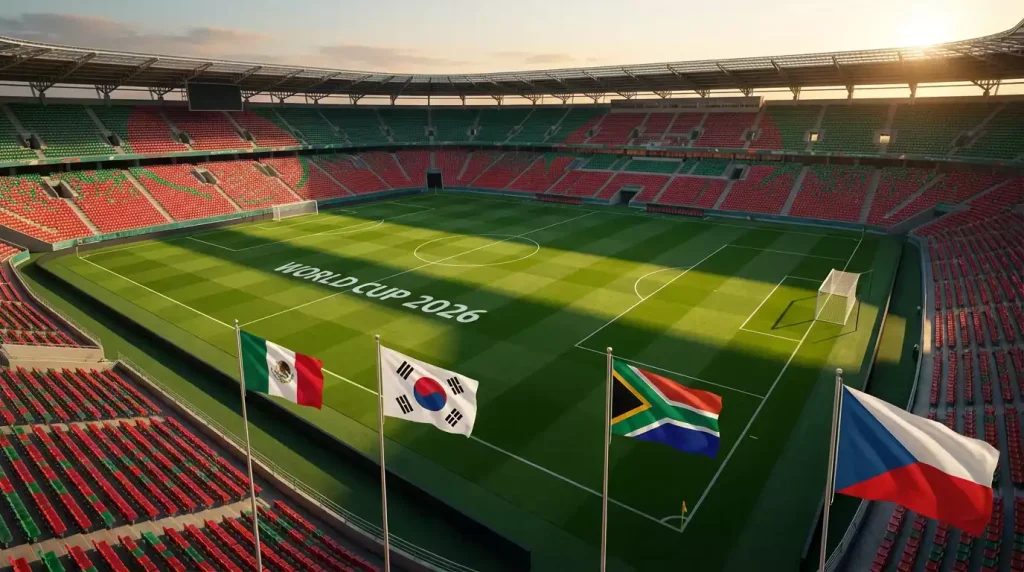
Table of Contents
Every World Cup begins with a single whistle, and in 2026, that whistle blows at Estadio Azteca on June 11th when Mexico faces South Africa in the tournament’s opening match. I’ve covered six World Cups now, and there’s something uniquely electric about that first game — the entire planet watching one stadium, one moment, one group setting the tone for everything that follows. World Cup 2026 Group A carries that weight, and Mexico understands the assignment better than anyone.
The group itself reads like a study in contrasts: a three-time host nation desperate to break a knockout-round curse, an Asian powerhouse chasing its 2002 glory days, an African qualifier returning to the world stage, and a Central European side representing a country playing under a relatively new name. Four nations, four distinct footballing philosophies, all converging in what promises to be one of the more compelling opening chapters of the expanded 48-team format.
Four Nations, One Dream: Group A at a Glance
I pulled up the FIFA rankings last week, and the spread in Group A tells an interesting story. Mexico sits around 15th globally, South Korea hovers near 23rd, Czechia lands in the low 40s, and South Africa occupies a spot in the mid-60s. On paper, this creates a clear hierarchy. In reality, World Cup group stages have a habit of shredding paper predictions into confetti.
The structure here favours Mexico and South Korea as likely qualifiers, but let me complicate that picture. South Africa’s qualification campaign showed a team playing with genuine cohesion under Hugo Broos, the Belgian manager who transformed their approach since taking over in 2021. Czechia — still adjusting to life without the Czech Republic branding in international football contexts — brings a squad mixing experienced Bundesliga and Premier League players with emerging domestic talent.
What makes Group A particularly watchable is the tactical diversity. Mexico plays possession-based football with quick combinations in tight spaces. South Korea emphasizes high pressing and rapid transitions. South Africa operates with disciplined defensive blocks and clinical counter-attacks. Czechia blends Central European technical proficiency with physical directness. When these styles collide, unpredictability follows.
The venue distribution adds another layer. All Group A matches take place across American stadiums — no Mexico City dates after the opener, which means El Tri loses some home advantage as the group progresses. South Korea travels well with one of the most dedicated away supporter bases in Asian football. South Africa and Czechia both bring passionate followings, though in smaller numbers given the travel distances from their home continents.
Mexico: The Hosts Open Their World Cup
Standing in the Azteca tunnel before a qualifier last year, I watched Mexican players touch the walls like pilgrims at a shrine. This stadium hosted two World Cup finals — 1970 and 1986 — and the ghosts of Pelé and Maradona seem to linger in the concrete. For Mexico, the 2026 tournament represents more than football. It’s vindication, celebration, and perhaps finally, breakthrough.
The narrative haunting El Tri spans decades: seven consecutive World Cups reaching the Round of 16, seven consecutive exits at that exact stage. Mexicans call it the “quinto partido” curse — the fifth game that never goes their way. In 2026, playing on home soil (even if most matches occur in American venues), the pressure to finally reach a quarter-final will be immense. I’ve spoken with Mexican federation officials who acknowledge this openly: anything less than quarter-finals will be considered failure.
The squad entering 2026 balances experience with emerging talent. Players like Edson Álvarez, now a Premier League regular, anchor the midfield with defensive intelligence and passing range. Santiago Giménez, whose goal-scoring exploits in the Eredivisie and beyond have made him one of CONCACAF’s most valuable strikers, leads the attack. The defensive line has undergone regeneration, with younger centre-backs stepping into roles vacated by the previous generation.
Tactically, manager Javier Aguirre — brought back for his third stint with the national team — has implemented a 4-3-3 system that prioritizes ball retention and patient build-up. Mexico doesn’t blast opponents; they suffocate them with possession, waiting for moments to accelerate through the channels. Against South Africa in the opener, expect Mexico to control tempo while probing for weaknesses.
The opening match carries specific psychological weight. Win convincingly, and Mexico establishes dominance over the group while energizing an entire nation. Draw or lose, and suddenly the quinto partido conversation shifts to whether El Tri can even escape the group stage. I’ve watched Mexican teams crumble under such pressure before — 2014’s opening draw with Cameroon springs to mind — but I’ve also seen them rise magnificently, as they did demolishing Germany 1-0 in 2018’s opener. The variance is real.
South Korea: Asian Ambitions in North America
Twenty-four years ago, South Korea co-hosted a World Cup and reached the semi-finals in one of the tournament’s most controversial and exhilarating runs. I was early in my career then, watching Guus Hiddink’s side stun Spain and Italy with performances that changed how the world viewed Asian football. The 2002 squad became national heroes, and every Korean team since has carried that legacy like a backpack filled with bricks.
The current generation understands the burden. Son Heung-min, now 33 and likely playing his final World Cup, remains the talisman — a genuine world-class attacker whose Tottenham exploits have made him a global star. Around him, a new wave of Korean talent has emerged through European academies and domestic development. Players like Lee Kang-in, established at Paris Saint-Germain, bring technical sophistication that previous Korean generations sometimes lacked.
South Korea’s qualification campaign through the AFC demonstrated both strengths and vulnerabilities. The Taegeuk Warriors dominated lesser opponents with aggressive pressing and quick transitions, but struggled against physical teams capable of bypassing their midfield. Japan exposed these issues repeatedly in recent fixtures, suggesting that South Korea’s ceiling depends heavily on matchups.
In Group A, the matchup matrix favours Korea’s style. Mexico’s possession game invites the counter-pressing that Korea executes brilliantly. South Africa’s defensive approach could be vulnerable to Korea’s movement and combination play. Czechia presents the trickiest puzzle — a physical European side capable of winning aerial duels and disrupting Korea’s rhythm. That September 17th fixture against Czechia might determine whether Korea finishes first or second.
The Korean Football Association has invested heavily in sports science and tactical analysis since 2018’s disappointing early exit. Training facilities rival European standards. The coaching staff includes multiple analysts tracking opponent patterns through AI-assisted video breakdown. Whether this translates to results remains uncertain, but the infrastructure supporting this Korean generation exceeds anything previous squads enjoyed.
South Africa: The Bafana Bafana Return
Fourteen years passed between South Africa hosting the 2010 World Cup and qualifying for another tournament on merit. That drought ended when Bafana Bafana secured their place through a gruelling CAF qualification campaign that saw them top a group including Morocco and Zimbabwe. Hugo Broos, the Belgian manager who previously led Cameroon to AFCON glory, has engineered a genuine rebuild.
The transformation happened through youth integration and tactical discipline. Broos famously dropped established veterans upon arrival, declaring that South African football needed new blood rather than recycled disappointment. Initially controversial, the decision now looks prescient. Players like Percy Tau, Themba Zwane, and Bongokuhle Hlongwane have formed a core that blends Premier Soccer League experience with international exposure.
South Africa’s tactical approach under Broos emphasizes defensive organization above all else. The 4-3-3 formation operates with narrow spacing, inviting opponents to attack wide before collapsing into central areas. Counter-attacks flow through Tau’s dribbling and Hlongwane’s pace — a combination that troubled Morocco repeatedly during qualification. Against Mexico in the opener, this blueprint makes sense: absorb pressure, frustrate the hosts, strike on the break.
The challenge lies in sustaining such intensity across three group matches. South Africa’s squad lacks the depth of European or South American opponents. Injuries to key players would devastate tactical plans. Additionally, the travel and climate adjustment — flying from African winter to North American summer — presents physiological challenges that Broos has acknowledged in press conferences.
Realistically, South Africa enters Group A as underdogs with upset potential rather than genuine qualification candidates. A draw against Mexico in the opener would be celebrated nationally. Victory seems improbable but not impossible — remember, South Africa held eventual champions Spain to a draw in 2010. The Bafana Bafana know how to rise for moments.
Czechia: Europe’s Dark Horse
When Czechoslovakia split in 1993, the footballing inheritance went mostly to the Czech side — the federation, the history, the infrastructure. Thirty-plus years later, Czech football has experienced cycles of brilliance and mediocrity, with Euro 2004’s semi-final run representing the peak and several missed tournaments marking the valleys. The 2026 World Cup offers a chance at redemption after failing to qualify for Qatar 2022.
The current Czech squad features players scattered across top European leagues. Patrik Schick, whose stunning long-range goal against Scotland at Euro 2020 went viral globally, leads the attack with clinical finishing. Tomáš Souček provides midfield presence and aerial dominance from his West Ham experience. Adam Hložek has developed into a versatile forward capable of playing across the front line. The spine exists; the question is whether peripheral pieces fit.
Czech football traditionally emphasized technical skill and intelligent movement, but the modern iteration under manager Ivan Hašek incorporates more direct elements. Expect long balls targeting Schick’s heading ability, quick switches of play exploiting width, and set-piece routines designed around Souček’s leap. Against smaller teams, Czechia dominates through possession. Against equals or superiors, pragmatism takes over.
Group A presents reasonable pathways for Czechia. Mexico and South Korea are clearly stronger on paper, but neither is invincible. If Czechia can draw one of those matches while beating South Africa convincingly, third place with potential advancement to the Round of 32 becomes achievable. The expanded format helps — eight best third-placed teams advance, meaning Czechia doesn’t necessarily need second place to continue.
The psychological barrier for Czech football involves big-stage performances. Recent tournaments have seen them exit in group stages or early knockouts despite possessing quality players. Whether this generation can overcome that pattern depends on the opening weeks. A strong start against South Korea could establish belief; a defeat might trigger familiar spirals.
Match Schedule: When and Where
Group A’s fixture list creates natural drama through sequencing. The opener — Mexico versus South Africa on June 11th at Estadio Azteca — kicks off not just the group but the entire tournament. Three billion people will likely watch that match. South Korea faces Czechia the following day, June 12th, at AT&T Stadium in Arlington, Texas. The 80,000-seat venue will host one of the tournament’s largest crowds, with Korean supporters expected to travel in significant numbers.
Matchday two brings Mexico against South Korea on June 17th at NRG Stadium in Houston. This fixture feels like the group’s pivotal moment — two favourites clashing with likely consequences for final standings. South Africa meets Czechia simultaneously at Lumen Field in Seattle, where the winner keeps survival hopes alive while the loser faces probable elimination.
The final matchday on June 22nd pairs Mexico with Czechia and South Korea with South Africa. Both matches kick off at the same time to prevent collusion, with venues in Kansas City and Philadelphia respectively. By this point, scenarios will have clarified: who needs wins, who can afford draws, who’s playing for pride.
For Canadian bettors tracking this group, the time zones align conveniently. Most Group A matches occur during afternoon or evening hours Eastern Time, meaning no middle-of-the-night viewing required. The June 11th opener kicks off at 5:00 PM ET — prime time for a Thursday evening that many offices will conveniently find reasons to leave early.
How It Unfolds: Our Prediction
After nine years analysing World Cup groups, I’ve learned to distrust certainty. That said, Group A’s power structure seems clearer than most. Mexico possesses the quality and motivation to finish first, though the opening match carries risk. South Korea has the tactical tools and individual talent to secure second place, though their physical limitations against European opposition concern me.
My projected final standings: Mexico first with 7 points (two wins, one draw), South Korea second with 6 points (two wins, one loss), Czechia third with 4 points (one win, one draw, one loss), South Africa fourth with 1 point (three draws or one draw, two losses). The key match is Mexico-South Korea on matchday two — the winner likely takes the group, while the loser faces a tighter path to qualification.
For betting purposes, Mexico to win the group offers reasonable value at current prices, though not exceptional. The more interesting play involves Czechia’s third-place potential — if you believe they can accumulate 4 points, their odds to advance as one of eight best third-placed teams become attractive. South Africa finishing with zero points is possible but not guaranteed; they’re a better team than rankings suggest.
The drama in Group A centres on Mexico’s curse narrative. Can they finally translate home advantage into knockout success? The answer won’t come until later rounds, but the group stage sets the psychological foundation. A dominant Group A performance — three wins, goals flowing, crowds roaring — would do more for Mexican confidence than any tactical preparation. Conversely, a stumble here could doom everything that follows.
I’ll be watching that June 11th opener with particular attention. The opening goal, the crowd response, the body language after setbacks — these details reveal more than statistics about how a team handles pressure. Mexico at Azteca, under those lights, carrying those expectations? That’s the World Cup distilled into ninety minutes. Group A begins the tournament, and Mexico begins Group A. Everything else follows from there.
